
This post was updated May 2026.
The first time we came to Spain in 1975, we spent our first days in Barcelona and then Madrid. Both are interesting big cities, with their attractions to be sure. (The Sagrada Familia in Barcelona was barely started then.) But when we made the short train trip from Madrid to Toledo shortly thereafter, that was when the first obvious “wow” factor of Spain kicked in. Even recently, when we made, perhaps, our tenth visit to Toledo, we are still convinced that this tiny walled city on the Tagus River has the most artistic and historical oomph per square meter of any city in Spain – and perhaps any city in the world, with the possible exception of Florence.
For a broader overview of where to go, what to eat, and how to plan your route through Spain, start with our Spain travel guide.
Toledo is a very small city and can easily be covered in a long day, which makes it an ideal day trip destination from Madrid. Once you get there, it can be covered on foot, if you’re able to handle the sometimes rough cobblestone streets and an occasional steep incline. Many of the very narrow streets of the medieval city of Toledo are too small for cars anyway, so there really isn’t much choice. In reality, the city is compact enough to navigate at a relaxed pace. Most major sites are clustered within easy walking distance of each other
I should emphasize that this small list of things to do on a day trip to Toledo is just that – a small sampling. There are many more sites worth visiting. And, while a day trip is an adequate introduction to the majesty of Toledo, an overnight stay and a second day wandering will also reward you with some of the nuances found, perhaps, in parish churches and the fascinating shops featuring the famous Toledo damasquinado, the art of inlaying different metals into one another — typically gold or silver into a darkly oxidized steel background.
Also, if you stay more than a day in the city, Toledo is famous for two culinary experiences. There’s the marzipan, a sweet of Moorish origin made of almonds, honey, sugar, and egg whites. It’s a little too cloying for my taste, but, if you like that sort of thing, worth a try. For a full meal, find a place that serves “Perdiz a la Toledana”, partridge slow cooked in wine, oil, and herbs.
The Best Things to Do in Toledo
The first thing to know is that it’s better to buy your entrance to Toledo attractions in advance.
The entrance to the Cathedral is tightly controlled with timed entries. You should book your time in advance. If you arrive without a booking, you may be in for a long wait, or a disappointment if they’re sold out for the day. A basic entry to the Cathedral is €12.
For the other attractions, buy the Toledo wristband, which gives you entry to seven Toledo attractions including: Real Colegio de Doncellas Nobles, Church of the Jesuits, San Juan de los Reyes, the old mosque of Cristo de la Luz, Santo Tomé, where you will find El Greco’s The Burial of Count Orgaz, the Church of El Salvador, and the old synagogue of Santa María la Blanca. The wristbands cost €14.
The Cathedral of Toledo
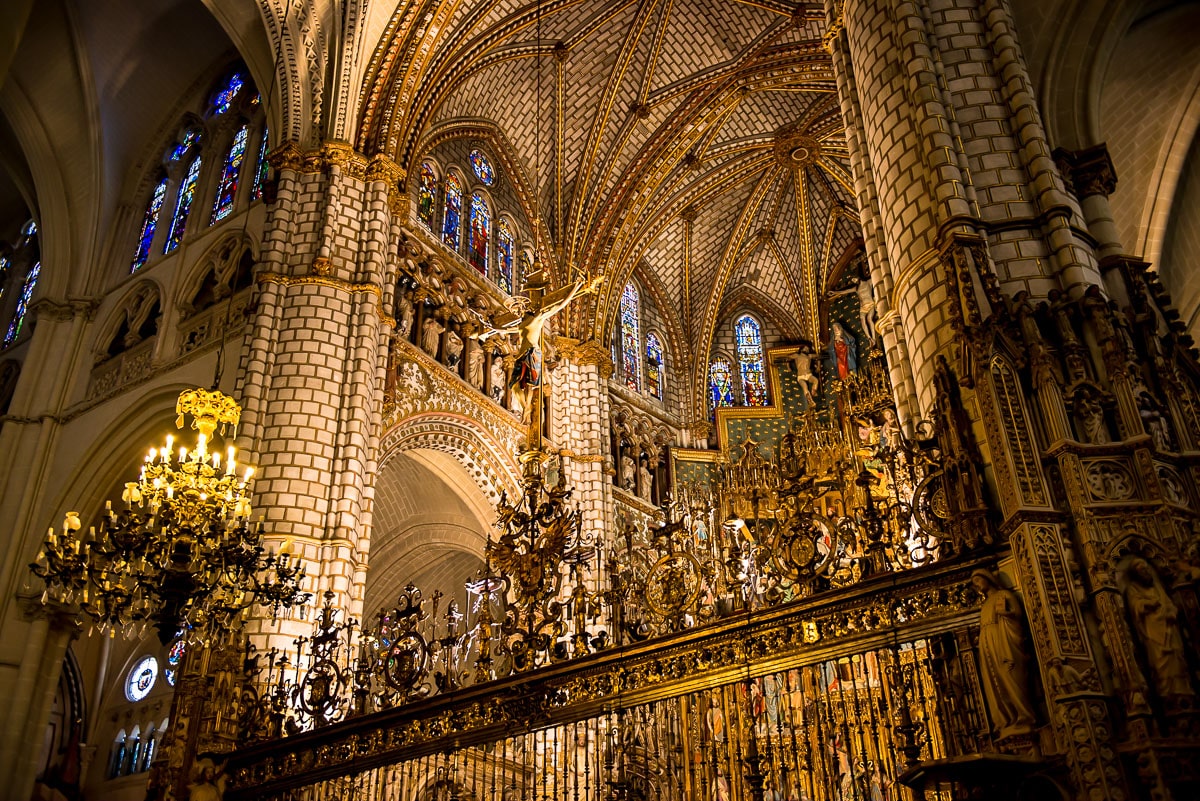
The Cathedral of Toledo, is the subject of a post of its own, and deserves a lengthy visit on its own. Some friends that we visited Toledo with on this trip spent three hours just in the Cathedral and admitted to not seeing it all. Yes, it’s that big, and its marvels are that many.
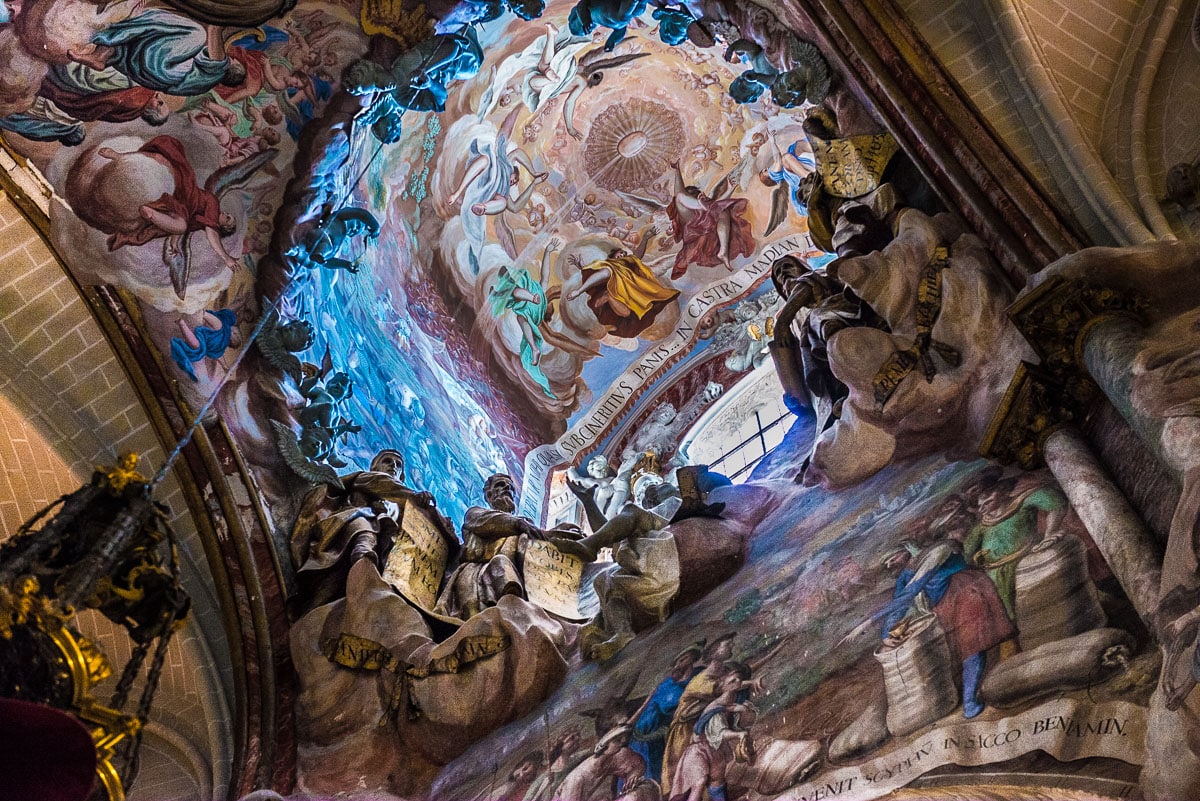
There are many attractions of note you can see in our post on the Cathedral, but two of our favorites are the Transparente and the choir. The Transparente is a unique feature that we’ve never seen the like of in any other church we have visited. A mixed media of sculpture and painting starts on the floor of the apse and leads the eye up and up until the sculpture gives way to frescoes and then a window that lights the entire work that represents the ascent into heaven.
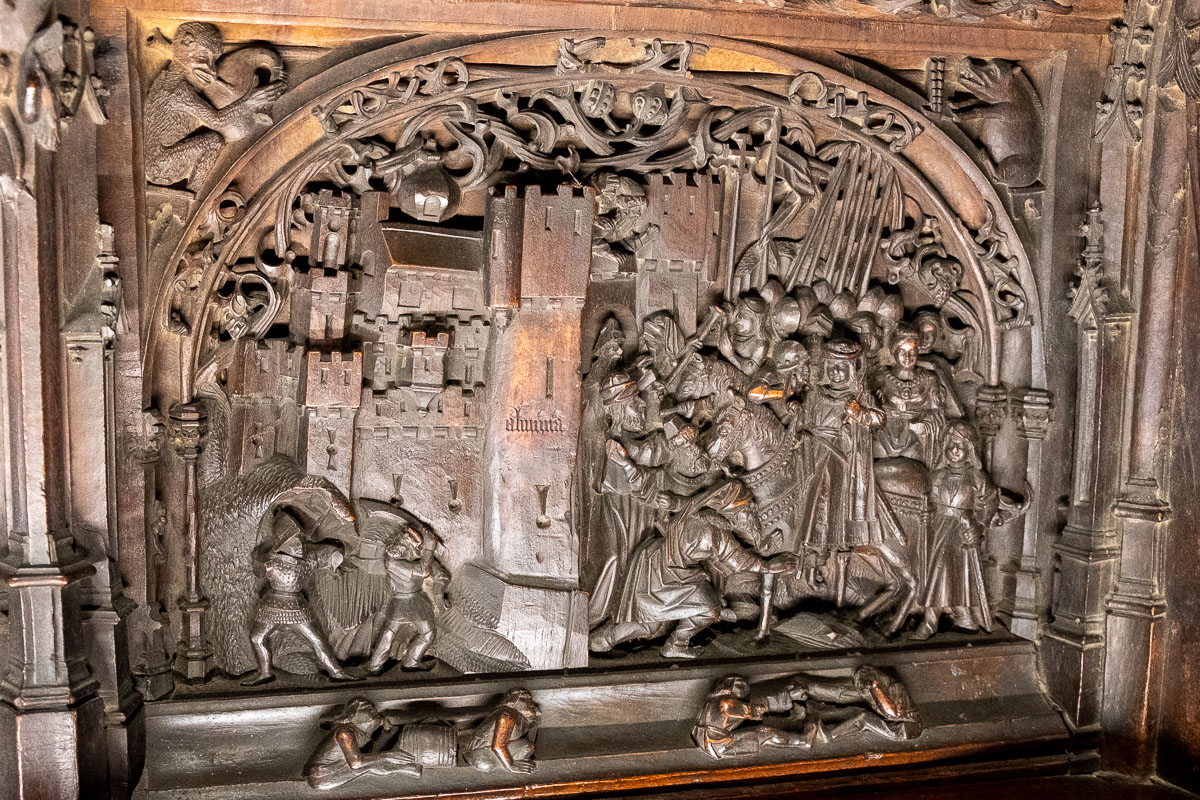
The enormous choir is distinguished by the exceptional carvings of the seat backs and the panels above the seats. On each seat back is a scene from the Catholic reconquest of Spain from the Moors, and culminates with the scene of the fall of the castle at Granada, the last Moorish city to fall to the Christians.
Please note that entrance to the Cathedral is tightly controlled with timed entries. You should book your time in advance. If you arrive without a booking, you may be in for a long wait, or a disappointment if they’re sold out for the day.
The Cathedral of Toledo is one of the 16 Great Cathedrals of Spain.
The Museum of El Greco
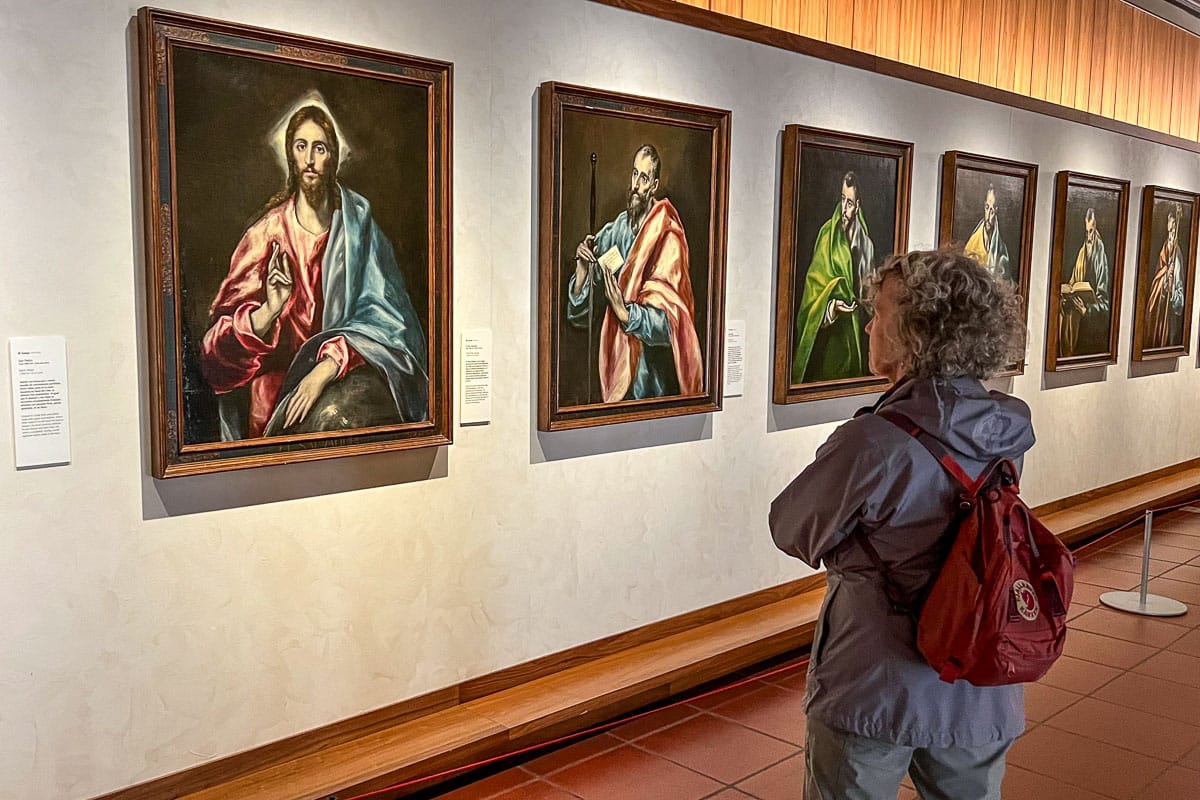
The small El Greco Museum (Museo del Greco), which has grown out of the old building which was actually El Greco’s home, houses a small collection of his paintings, in particular his series of the apostles. Here you can get very close to his smaller works and marvel at his revolutionary techniques of brush stroke, color, perspective, and elongation of figures. When you have this as a base for your appreciation of El Greco, his much larger works in The Prado, the Toledo Cathedral, and The Burial of the Count of Orgaz in Toledo’s Iglesia de Santo Tomé are rendered even more poignant.
The Mosque of Cristo de la Luz
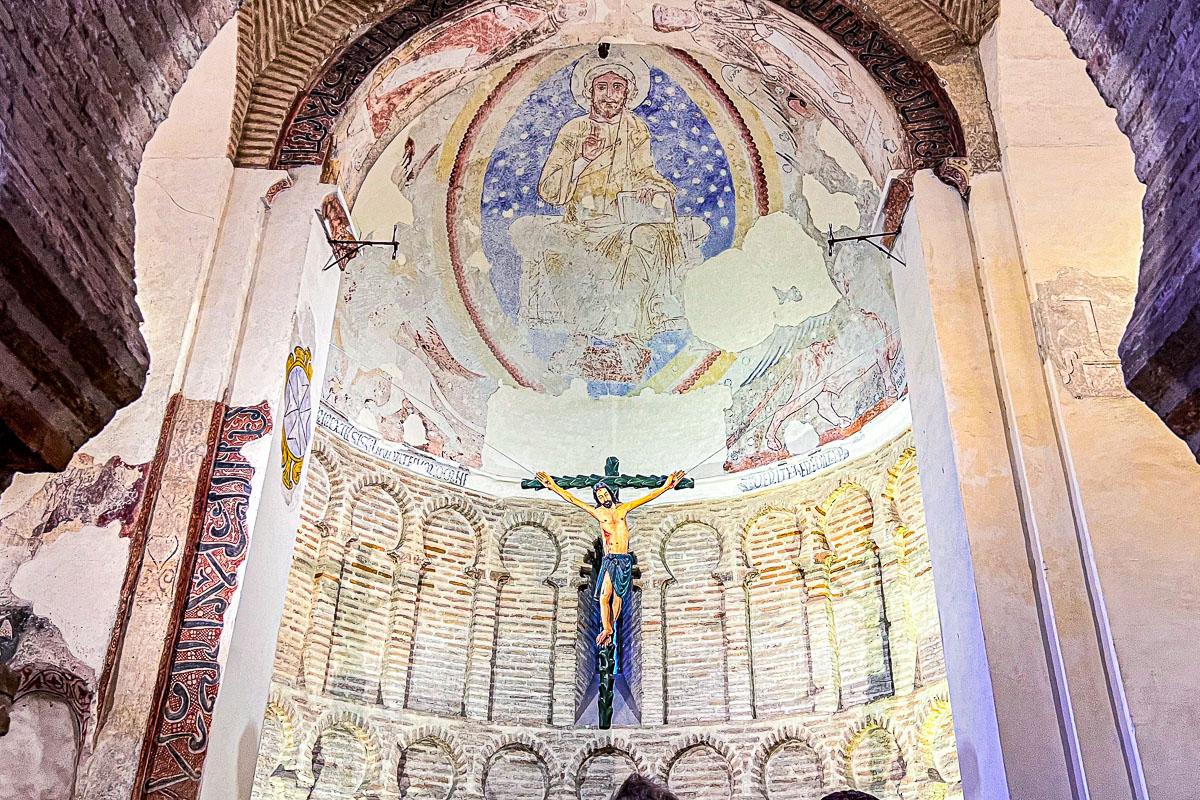
Originally built as a mosque in the year 999, this small building shares evidence of its original purpose with a later conversion into a Christian church by King Alfonso VI after the reconquest of Toledo in 1085. It’s a tiny structure, only about 8 x 8 meters, and so doesn’t need much time to see it. I particularly like the crude two-dimensional Christ in heaven painted on the dome, as well as the Arabic script which remains on the pillar to the left.
Monastery of San Juan de los Reyes
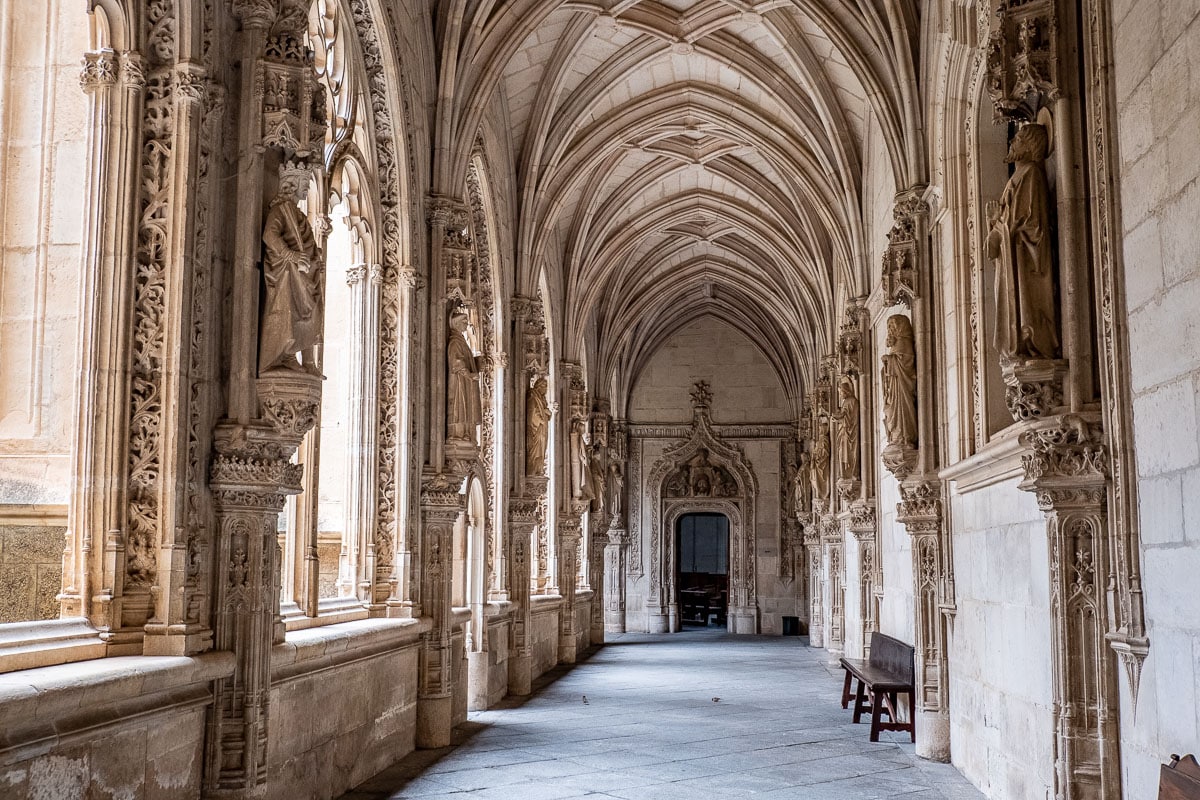
The Monastery of San Juan de los Reyes was originally commissioned by Fernando and Isabel to commemorate the birth of their son Prince John and the consolidation of their united kingdom. It was also intended to be their mausoleum. (They later chose to be buried in Granada’s Royal Chapel after conquering the city in 1492.)
It is relatively new, by Toledo standards, having been started in 1477 and completed in 1504. It was severely damaged during the Napoleonic wars of the early 1800s. Restoration was begun at the end of the 19th Century but only completed in the 1960s.
Synagogue of El Tránsito
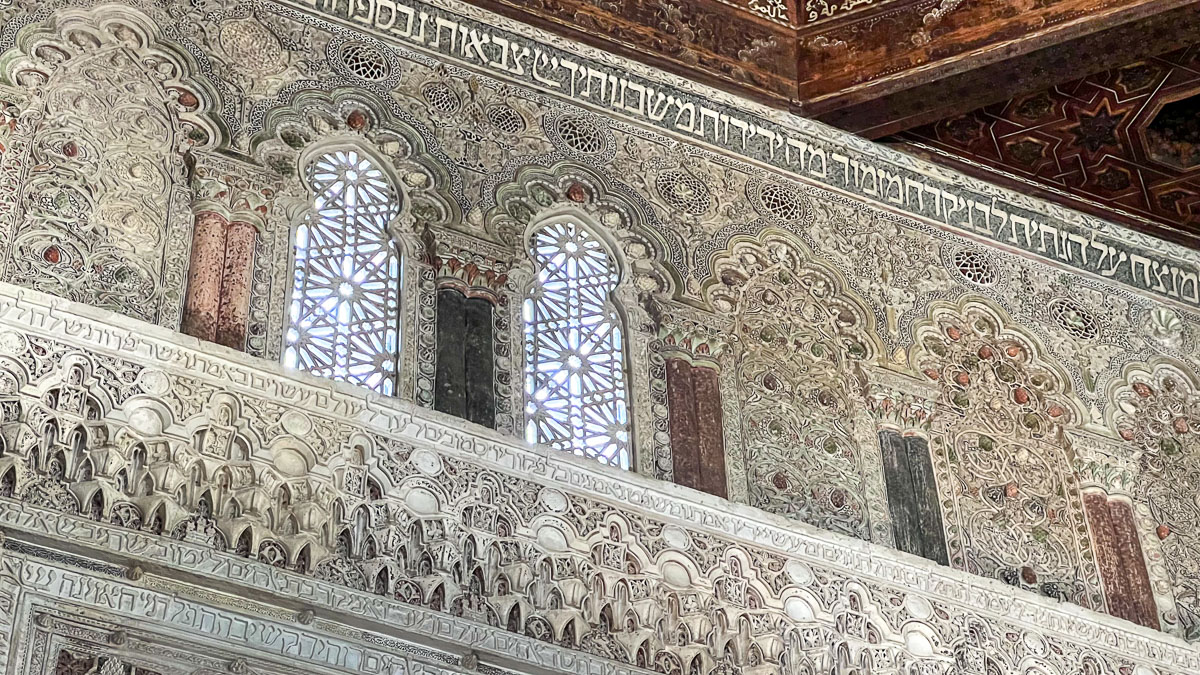
The Synagogue of El Tránsito was originally built in 1357 as a private place of worship for the Jewish counselor to King Pedro of Castilla, Samuel ha-Levi Abulafia. It was converted to a church after the expulsion of the Jews from Spain in 1492, and like San Juan de los Reyes, was damaged during the Napoleonic Wars when it was used as a barracks. The synagogue became a museum in 1910, and is known today as the Sephardic Museum. When you tour the small museum with its Jewish artifacts, note the stucco decoration, Mudéjar style, and women’s gallery. The Hebrew script around the ceiling and the carvings are reminiscent of Moorish palaces and mosques throughout Spain.
Synagogue-Church of Santa María la Blanca
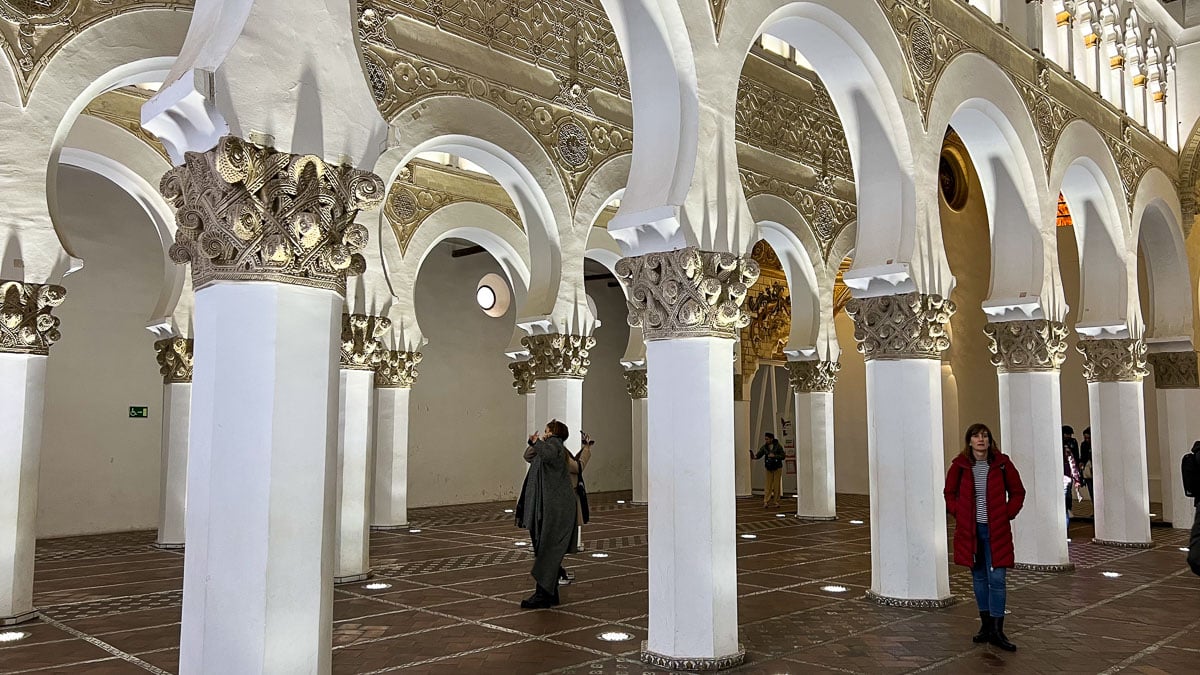
Like El Tránsito, Santa María la Blanca (Holy Mary the White), started life as a synagogue built in the Mudejar style in the early 13th Century. It, too, was appropriated by the Catholic Church, albeit earlier than El Tránsito, i.e. after persecution of the Jews in the late 14th Century. Today, take special care to admire the carved capitals of the pillars and the simple Moorish arches. There is also a Renaissance style apse added in the 16th Century in the former location of the synagogue’s ark.
The Visigothic Museum
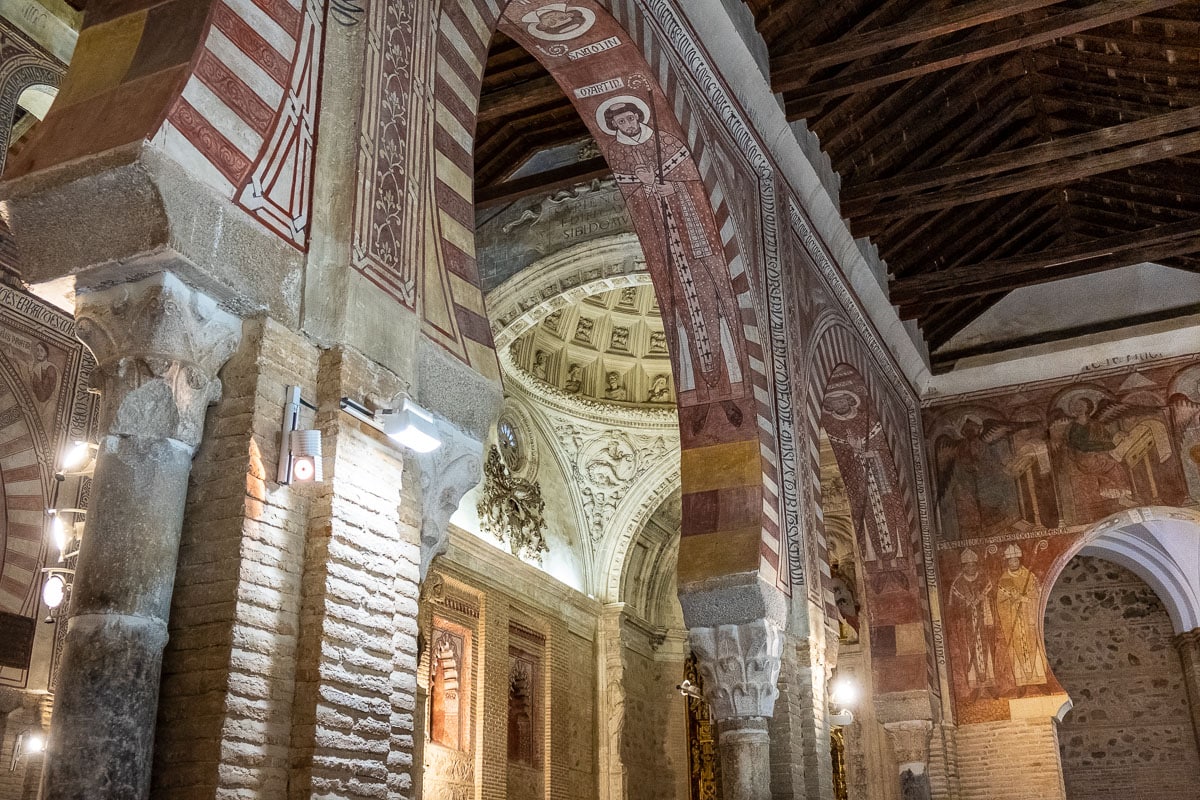
What was formerly the Church of San Román has been repurposed as the Visigothic Museum. The church was built in the Mudéjar style in the 13th century on the site of an old Visigothic structure and probably an ancient Roman building. Today, it serves as a reminder that the Iberian Peninsula was under Visigothic control until the Moorish invasion of 711, and that Toledo was, in effect, the Visigothic and Christian capital of the region.
There are numerous archaeological pieces on display dating from the 6th to the 8th centuries, as well as paintings, documents and precious metalwork, and funeral offerings from nearby the Carpio de Tajo necropolis. The frescoes that cover the walls of the church are Romanesque and date from the 13th Century.
The View of Toledo from the tower of San Ildefonso
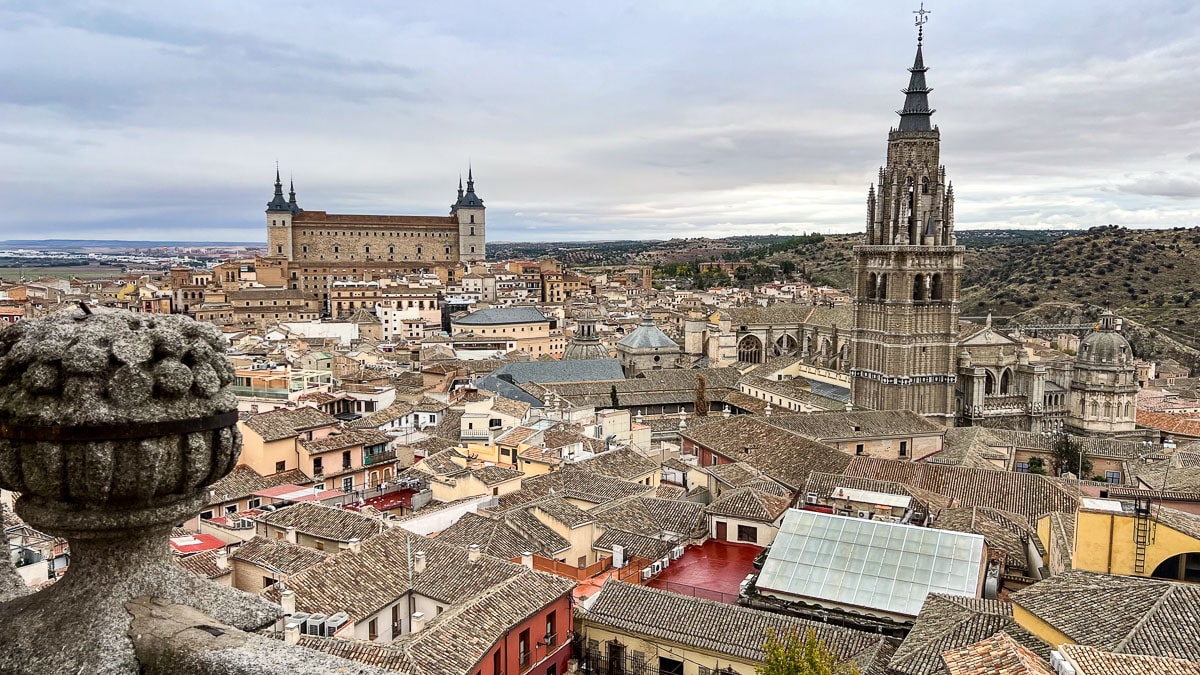
San Ildefonso (Iglesia de San Ildefonso) is the Jesuit church in Toledo and is yet another Baroque blot on the artistic history of earlier eras of Toledo. The church dates from the 17th Century and, if you like that sort of thing, is worth a quick tour. But the best reason to visit San Ildefonso is to climb the 131 steps up the tower to get a look over the Cathedral and Alcazar (Castle) of Toledo. It doesn’t compare to El Greco’s painting of a Toledo overlook, but it’s nice to get some sort of perspective on the labyrinthine warren that is this city.
The Alcazar
At the highest point in Toledo, and just near the Plaza de Zocodover, is the Alcazar (Castle) of Toledo. Originally built in the 3rd Century, today, in itself, it’s not much to look at. It’s major distinction is the part it played in the history of the Spanish Civil War. It was a Nationalist hold out against Republican forces for ten weeks in 1936, until the siege was lifted. Most of the building was destroyed then, and was rebuilt between 1939 and 1959. Today, the Alcazar houses the Army Museum of Spain and the Regional Library of La Mancha.
The City Gates
As you do your walking tour of Toledo, be sure to take note of the various interesting gates to the ancient city. The Puerta del Sol, The Puerta de Bisagra, and of course the medieval bridge (the Puente de Alcantara) are worth some extended admiration. If you’re lucky, as we once were, you’ll find one of the gate portals open and you’ll be able to climb to the top of the Puerta del Sol and get the view the defenders of the city once had of their attackers. And, the channels for the boiling oil the defenders poured on the invaders seven centuries ago are still there.
How to get to Toledo from Madrid
Toledo is an easy day trip from Madrid. There are trains at least every hour from Madrid Puerta de Atocha station that take just over 30 minutes to arrive at the beautiful Toledo train station. Train tickets are about €30 for a round trip. (Be sure to book as far in advance as you are able. Tickets tend to sell out a couple days in advance, especially for the morning trains from Madrid to Toledo, and the evening trains in the other direction. You could get stuck in Toledo.) From the station, it’s easiest to get up to the center of Toledo’s old town at the Plaza de Zocodover by taking a taxi. A taxi trip to and from the train station to the Plaza de Zocodover will run you about €5 each way.
Hotels in Toledo
There are plenty of lovely hotels to choose from in Toledo. Among the highest rated are the Casa de El Greco, the Casa Palacio Rincón de la Catedral, and the La Casa de Sillería.
Guided tours in Toledo
If you want the best guided tour experience possible, and one that encompasses most of the attractions above led by an actual university level professor, consider Context Travel’s day tour from Madrid. The price is high, but includes a higher level guide than you’ll get from most services, and also includes all transport from Madrid, including the train tickets and transport from the train station in Toledo into the city.
Tours of Toledo are also available from Viator and Get Your Guide.
Frequently Asked Questions: Things to Do in Toledo, Spain
Is Toledo worth visiting as a day trip from Madrid?
Absolutely — Toledo is one of the best day trips from Madrid, and it’s remarkably easy to get there. High-speed trains from Madrid Atocha station reach Toledo in just over 30 minutes, and trains run at least hourly. Toledo’s walled old city is compact enough to cover most of its highlights on foot in a full day, though the city also rewards an overnight stay if you want to explore at a more relaxed pace and experience the city after the day-trippers leave.
How do I get from Madrid to Toledo?
The easiest way is by high-speed train from Madrid Puerta de Atocha station. The journey takes about 33 minutes and round-trip tickets cost roughly €30. Trains run frequently throughout the day, but morning departures from Madrid and evening returns fill up fast — book as far in advance as possible to avoid being stranded. From Toledo’s train station, take a taxi or bus up to the Plaza de Zocodover in the old city center, as it’s a steep uphill walk.
How much time do you need in Toledo, Spain?
A full day (7–8 hours) is enough to visit Toledo’s main highlights, including the Cathedral, El Greco Museum, and two or three other sites. However, Toledo rewards slower exploration — the Cathedral alone can easily occupy two to three hours, and getting lost in the medieval alleyways is part of the pleasure. If you have flexibility, consider staying overnight to enjoy the city in the evening when the day crowds have gone and the old city takes on a magical atmosphere.
What is Toledo, Spain best known for?
Toledo is best known for three things: its extraordinary Cathedral, which is one of the greatest Gothic churches in the world; its association with the painter El Greco, who spent most of his career here; and its unique history as the “City of Three Cultures,” where Christians, Muslims, and Jews coexisted for centuries, leaving behind an extraordinary layering of architectural styles. Toledo is a UNESCO World Heritage Site and has more art and history concentrated in a small area than almost anywhere else in Spain.
What is the best thing to see in Toledo?
The Toledo Cathedral is the undisputed highlight — a Gothic masterpiece containing one of the world’s finest collections of religious art, including works by El Greco, Goya, and Titian, and the breathtaking Transparente, a unique Baroque sculptural and painted altarpiece that floods the apse with light. Give yourself at least 90 minutes to two hours inside. The El Greco Museum, the Synagogue of El Tránsito, and the Monastery of San Juan de los Reyes are all close behind.
Is Toledo, Spain walkable?
Yes — the historic center of Toledo is best explored entirely on foot, as most of its narrow medieval streets are too small for cars. However, visitors should be aware that Toledo is hilly and the streets are cobblestoned, which can be tiring on knees and ankles. Comfortable, broken-in walking shoes are essential. The main sites are clustered within a relatively compact area, so distances are short even if the terrain is uneven. From the train station, take a taxi or bus up to the old city rather than walking the steep approach.
What food is Toledo, Spain known for?
Toledo’s two signature foods are partridge (perdiz toledana) — slow-cooked with garlic, bay, vinegar, and white wine in a classic Castilian preparation — and marzipan (mazapán de Toledo), which is considered the finest in Spain and has been made here since the Middle Ages. You’ll find marzipan in almost every bakery and sweet shop in the city, often shaped into elaborate figures. A meal of partridge followed by a piece of Toledo marzipan is as local an experience as the Cathedral itself.