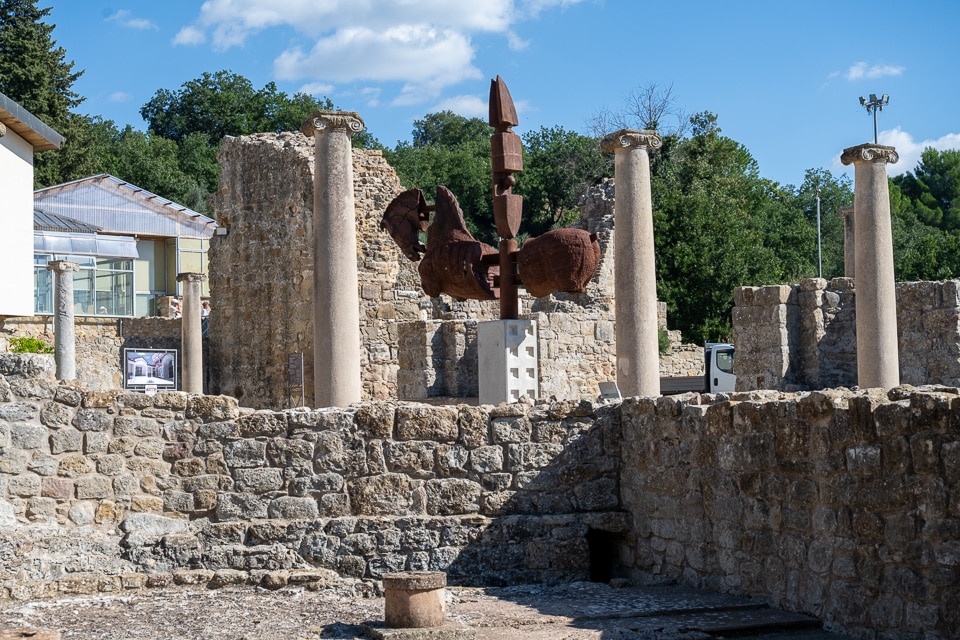
This year was our second visit to Sicily. The first was all the way back in 2011 and we concentrated then primarily in the south of the island on the Greek ruins in Agrigento and Siracusa. Back then, I’m not even sure that I was aware of the Villa Romana del Casale.
In fact, even though I’m a notorious Roman history nerd, I’m not exactly sure I would have known about it even now if I hadn’t done a cursory search of “best things to do in Sicily.”
Disclosure: This post may contain affiliate or sponsored links. If you book or buy through them, we may earn a small commission at no extra cost to you. As an Amazon Associate, we earn from qualifying purchases. Some of our travel is hosted, but we accept invitations on the understanding that what we write is our own. Read our full disclosure.
Before that search, I was vaguely aware of the Villa Romana, because I had seen reproductions of the ancient “bikini girls” mosaics somewhere, but hadn’t bothered to find out where they’d come from. So, when I did that minimal research that we always do before stepping on new ground, I was very pleased to find accounts and images of the mosaics at Villa Romana, along with glowing reports that they were among the most extensive, artistic and best-preserved examples of ancient Roman mosaic art. When we got there, we weren’t disappointed.
For a broader overview of where to go, what to eat, and how to plan your route through Italy, start with our Italy travel guide.
What Is the Villa Romana del Casale?
The Villa Romana del Casale is a luxury country estate built by a very wealthy Roman in the early 4th century AD. It was constructed on top of an earlier farm’s villa.
Despite usually meticulous Roman record keeping, it’s not definitively known who owned it. Speculation includes the co-emperor Maximian, who ruled contemporaneously with Diocletian in the late 3rd and early 4th centuries. (If you want to see Diocletian’s architectural taste, check out his spectacular palace at Split, Croatia.) It is known that Maximian retired to southern Italy after various intrigues that resulted in him no longer being emperor.
The floors of the villa are covered with about 3,500 square meters (38,000 square feet) of mosaics, which place the Villa among the largest Roman collections still in place.
A 12th-century landslide buried the villa, which is why the floors survived. Unfortunately, the walls that were covered with spectacular frescoes did not. The major archaeological excavations ran from 1950 to 1960.
The Villa became a UNESCO World Heritage Site in 1997. You can see the list of UNESCO World Heritage sites in Italy with posts about ones we’ve visited.
The Mosaics
The primary reason for visiting the Villa is the mosaics. There are hundreds of them, and all are spectacularly executed. Clearly, whoever owned and built this villa had the influence and wherewithal to hire the best mosaic artists of the empire.
The Baths and the Lady of the House
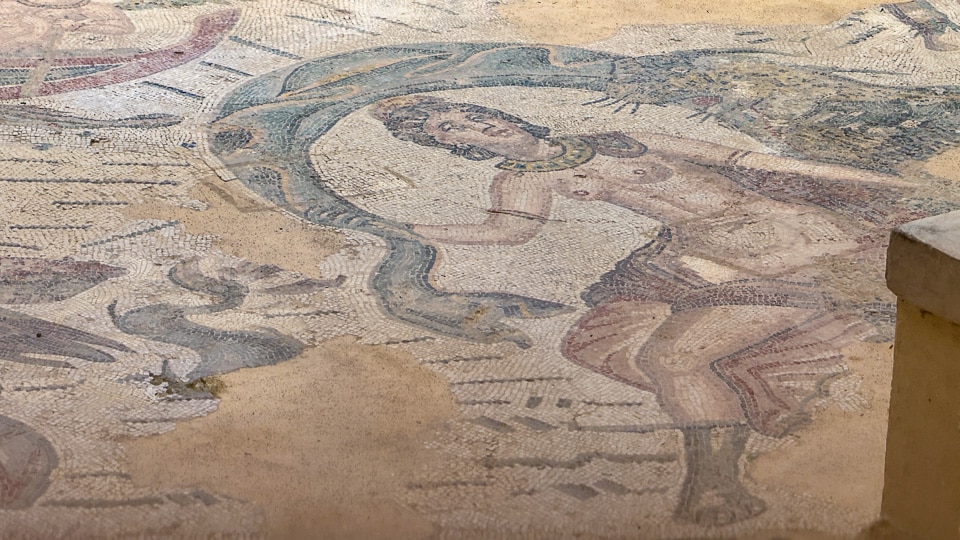
When you enter the villa site, the first thing you’ll see is the ruins of the baths. I’ve always been interested in Roman baths we’ve seen throughout the world, because the whole idea of a three-part soak and steam seems to me the epitome of luxury. When you know how the baths operated – a furnace at one end which heated not only the water but also the floors and walls through an ingenious chimney system – you can get a somewhat educated view of the remnants of what were large baths that could clearly serve many bathers at once.
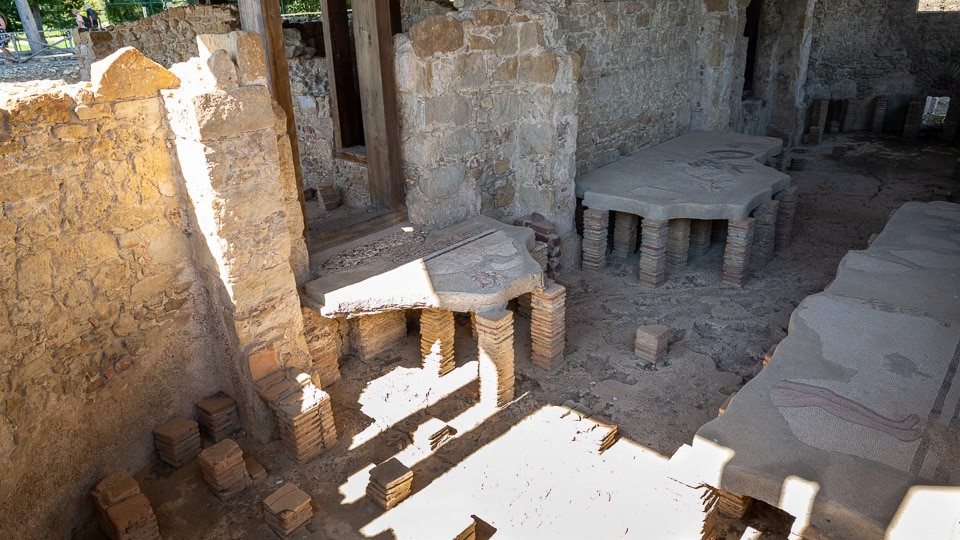
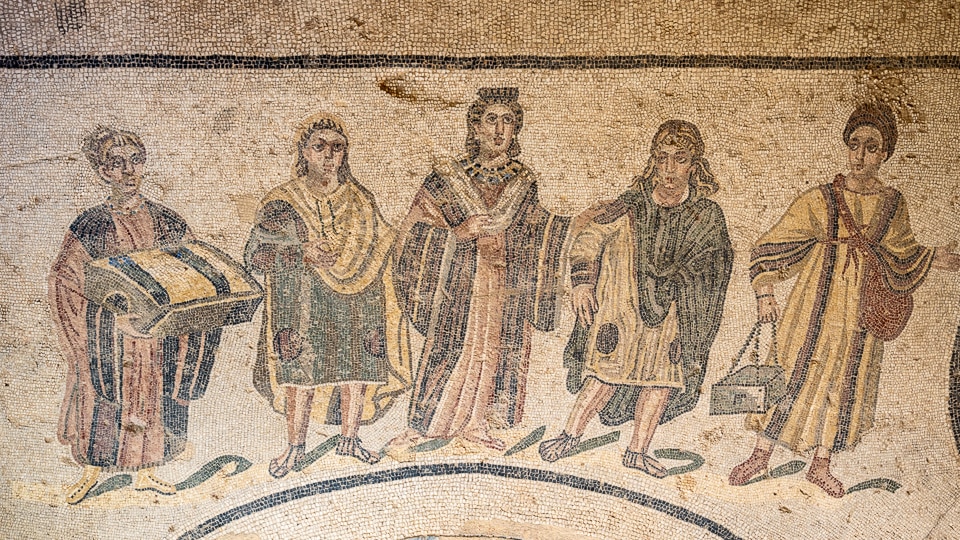
Unfortunately, the view of the mosaics in the baths themselves is severely restricted – you can only catch a glimpse of the actual bathing area mosaics through a small opening in the fence. The mosaic of the women preparing for the bath is not actually in the bath area.
The Peristyle
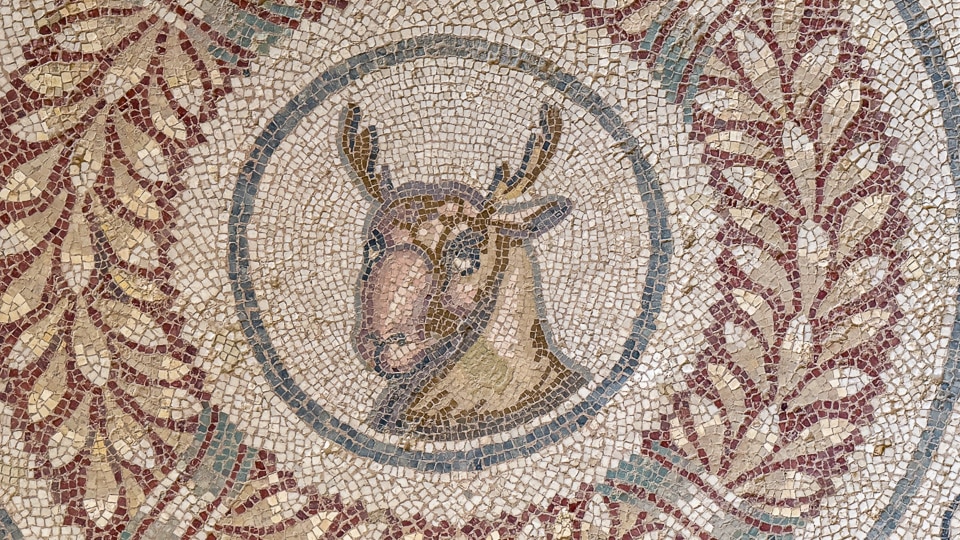
Once past the baths, you enter the covered and restored area of the Villa itself. There you will take a few steps up onto an elevated walkway which has been constructed to wend its way through the villa and from which you can get a good view of the mosaics in all the rooms.
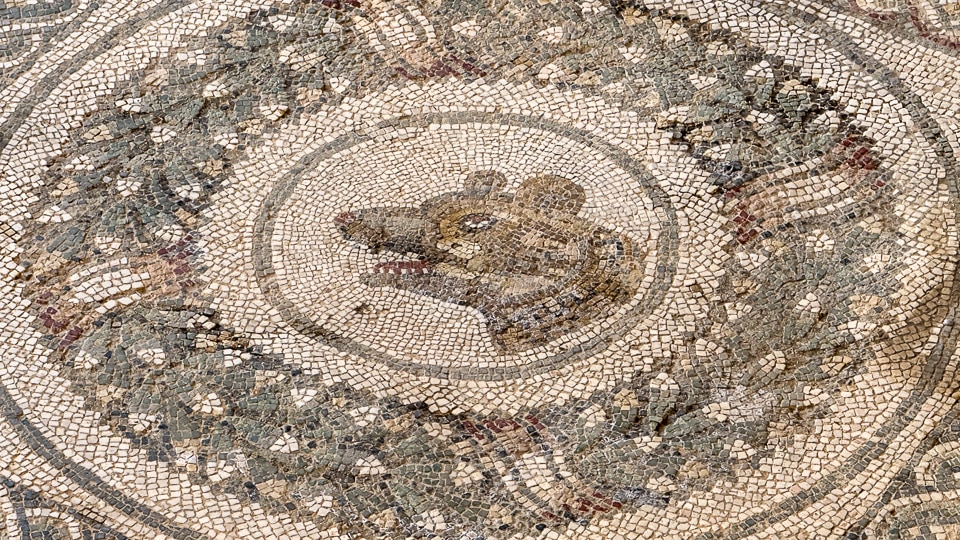
The first stop is the large courtyard – the peristyle – which is surrounded on all sides by a walkway featuring dozens of medallions of the heads of animals. If you wanted, you could spend an hour admiring these alone. But, they are static portraits, and purely decorative rather than narrative like the mosaics to come.
The Small Hunt
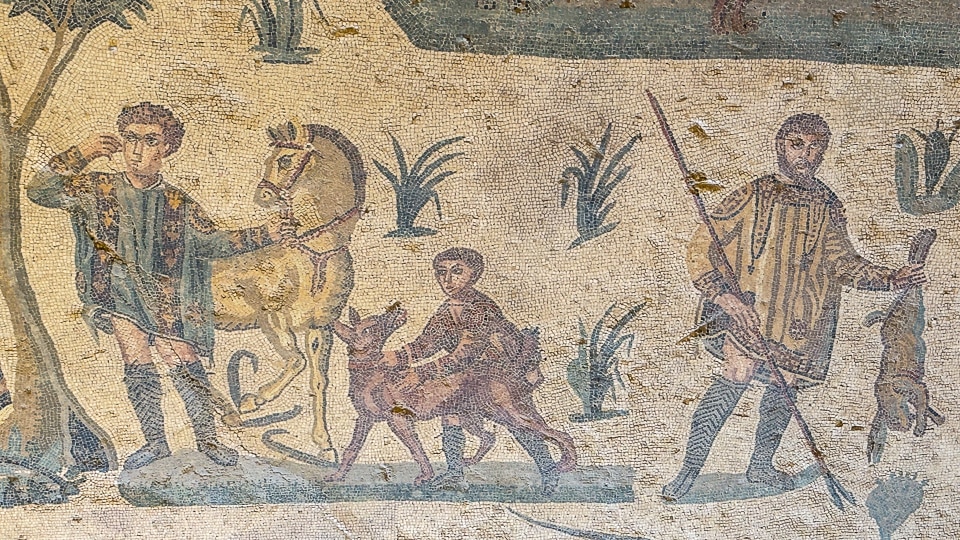
The so-called room of the Small Hunt is a good sized room that features many scenes of hunting game, probably for the food as well as sport value. This room depicts more of a family vibe of the owners hunting the local area, and actually bringing home their prey. You can walk all the way around the room and admire several distinct scenes.
The Great Hunt
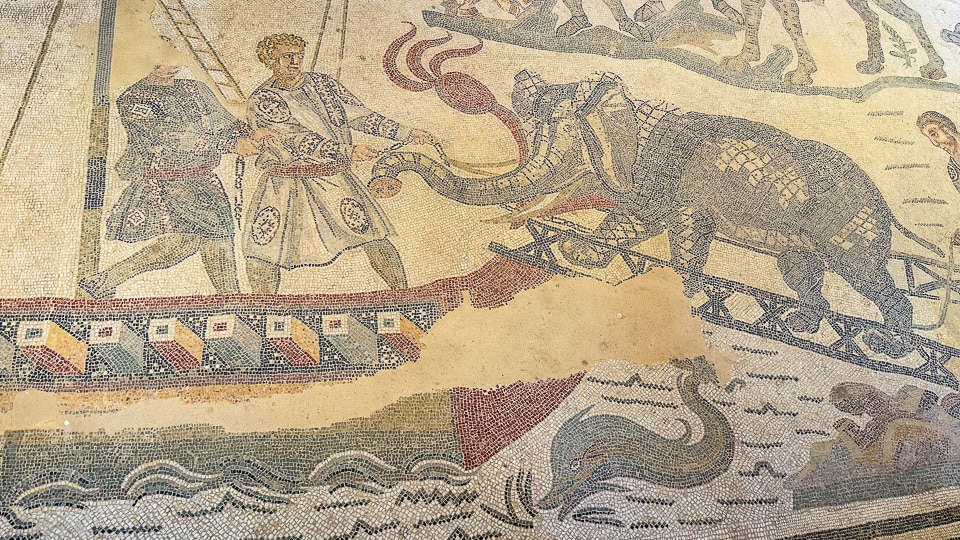
The Great Hunt room is the real highlight of the villa. It’s an enormous room that runs the entire width of the villa and encompasses dozens of scenes of the hunting and capture of large exotic animals such as elephants, rhinos, lions and more. What differs primarily from the small hunt, other than the animals themselves, is that the animals are being captured rather than killed, and are then being loaded into carts and eventually ships for transport to Rome, where they’ll be displayed to the populace.
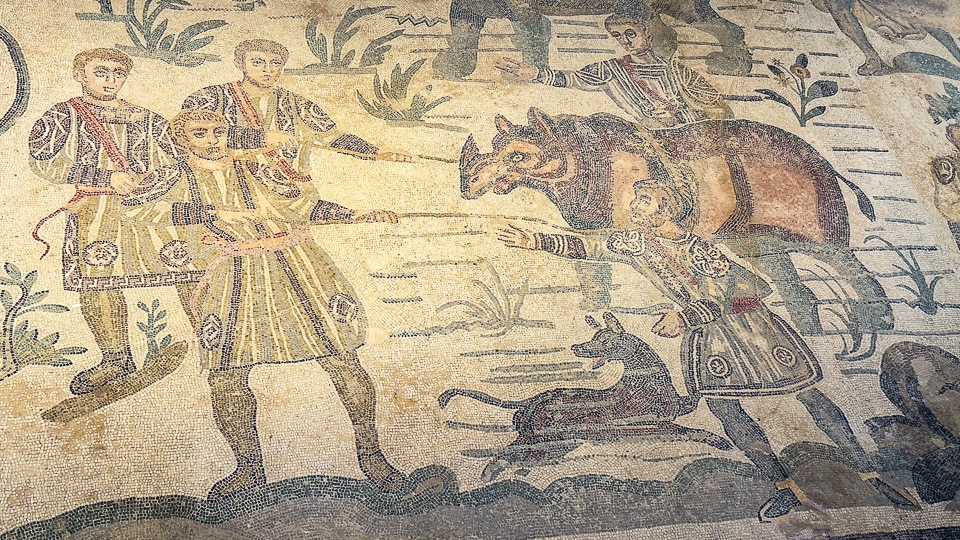
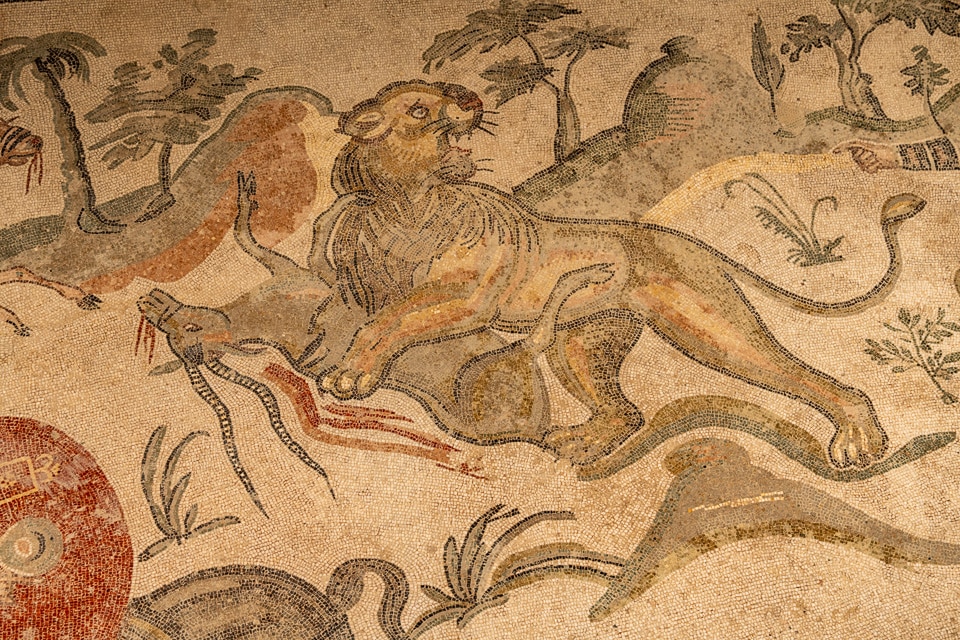
Not all the scenes of the Great Hunt involved capture, as you can see from this depiction of a lion taking down an antelope. One has to ask how far the Roman hunters had to venture into Africa to capture these animals for display in Rome. More evidence of the determination and industry of the Romans, even if for dubious purposes.
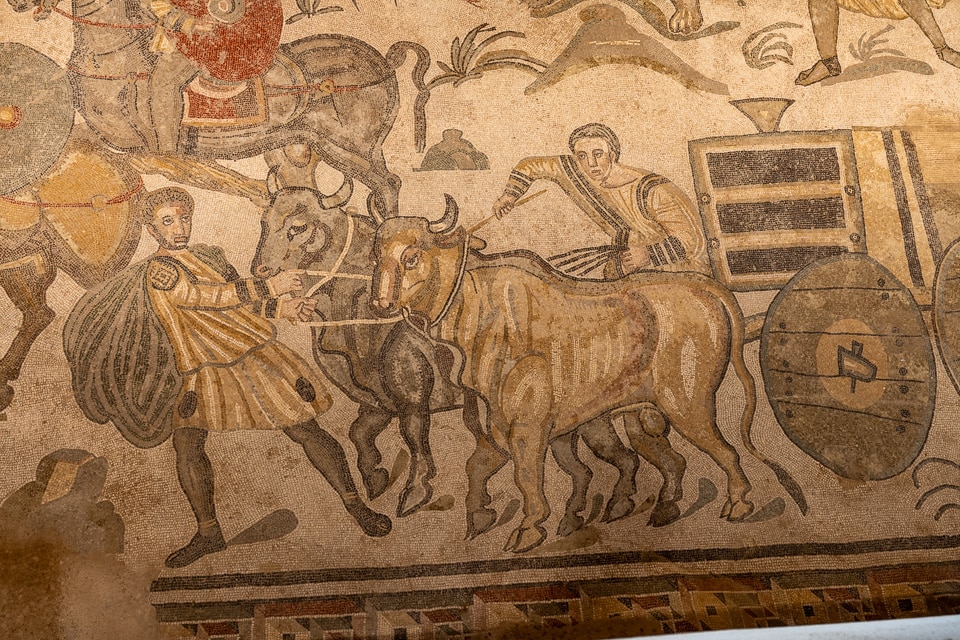
It is thought that the animals were brought to Rome not to be put in benign zoos, but to be displayed in the Colosseum and other venues and killed there. There are more than 30 words for “kill” in Latin, by the way. And as we know well, the Romans loved their death spectacles, both human and animal.
The Bikini Girls (Room of the Ten Maidens)
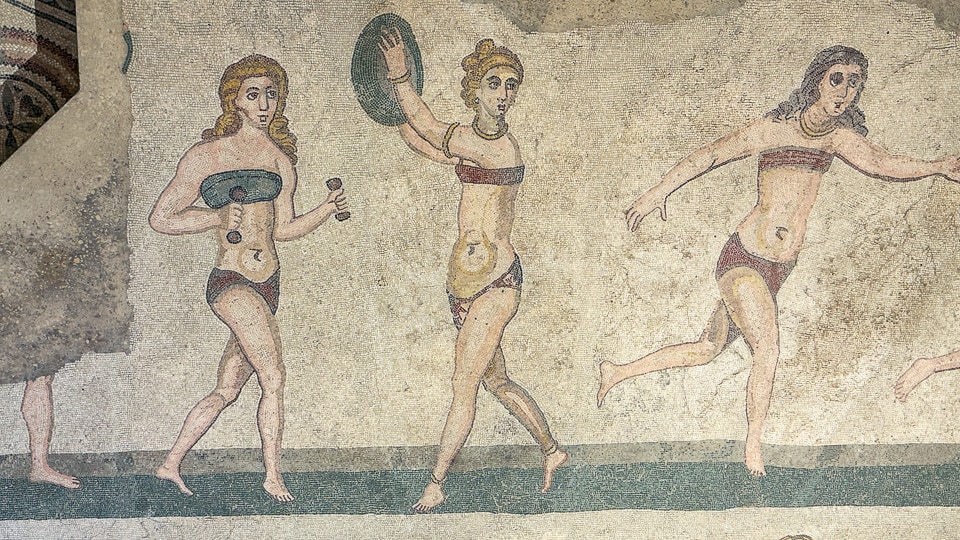
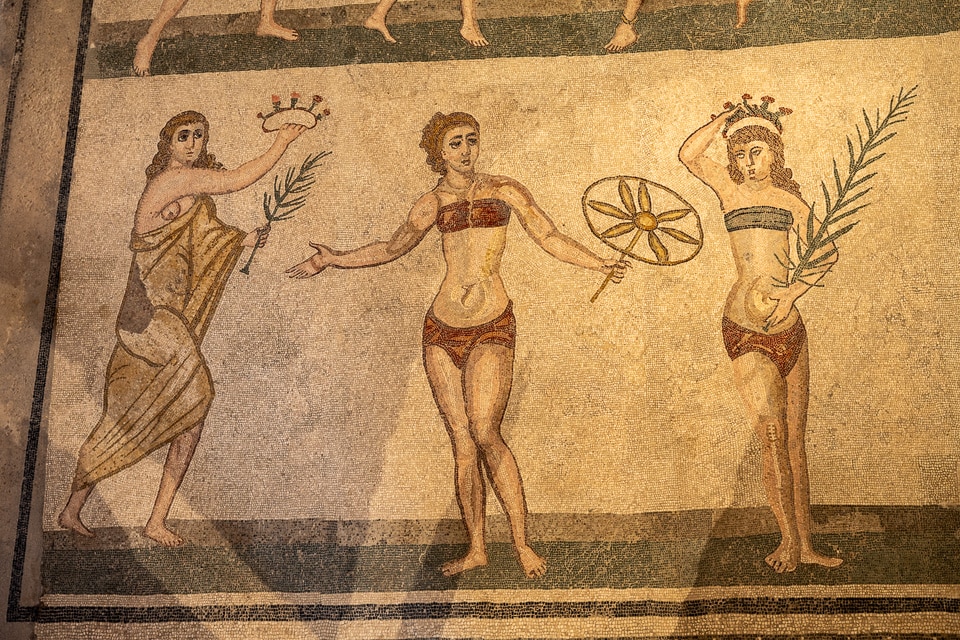
Perhaps the most famous mosaics are in the room of the so-called “bikini girls” who are really depicted as athletes both in the throes of competition as well as receiving their just laurels. The room is probably more correctly known as the Room of the Ten Maidens. I believe these were the only mosaics of the villa that I was vaguely familiar with before we arrived at the villa, probably because depictions of them are in souvenir stands all over Sicily. The room is quite large, signifying perhaps the feminine influence in the villa’s decoration, or less politically correct, a consul’s attraction to the feminine form.
Hercules and the Giants
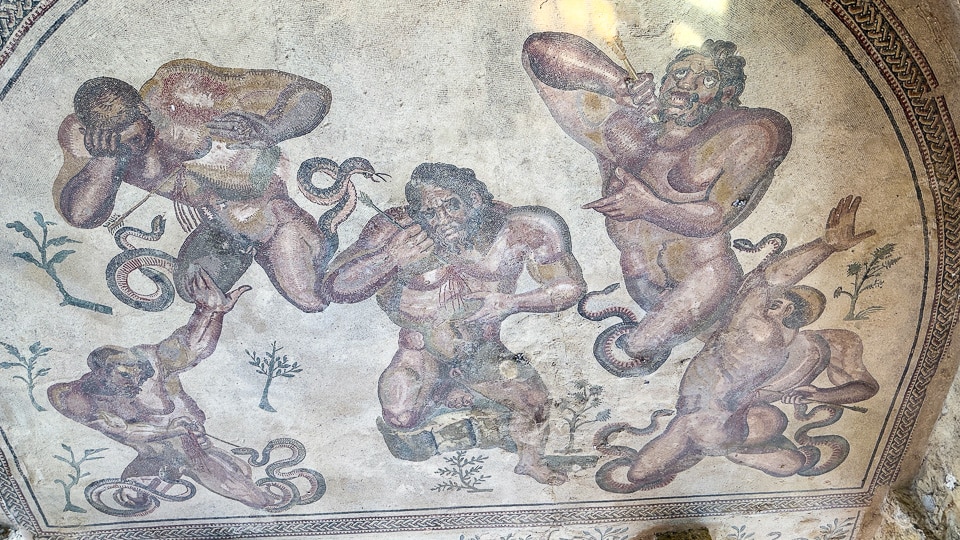
In Greek (and Roman) mythology, the Olympian gods had to battle the Giants for control of the world. In this battle, they were aided by the demi-god Hercules, who dispatched the Giants with his arrows. It’s helpful to know a little about the Greeks and Romans when you’re looking at these sorts of sites.
Ulysses and the Cyclops
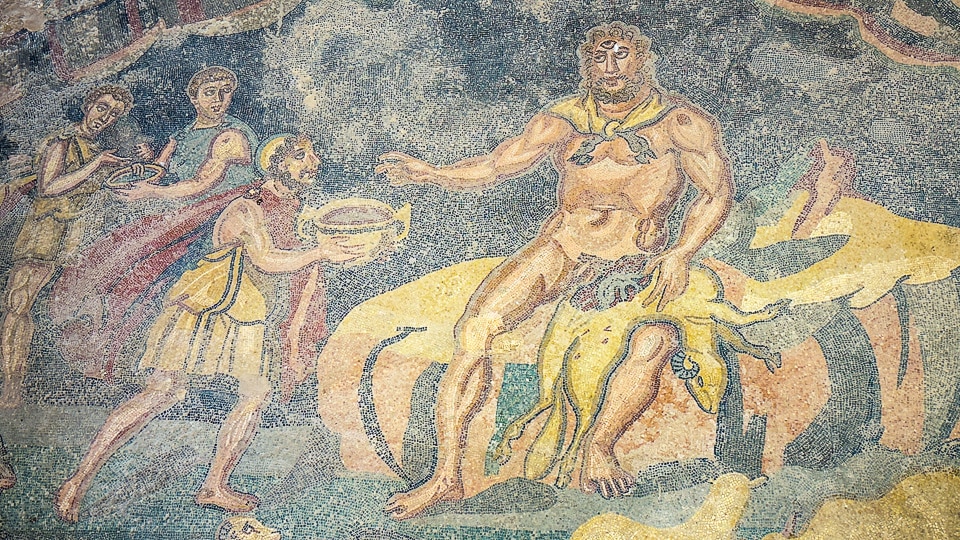
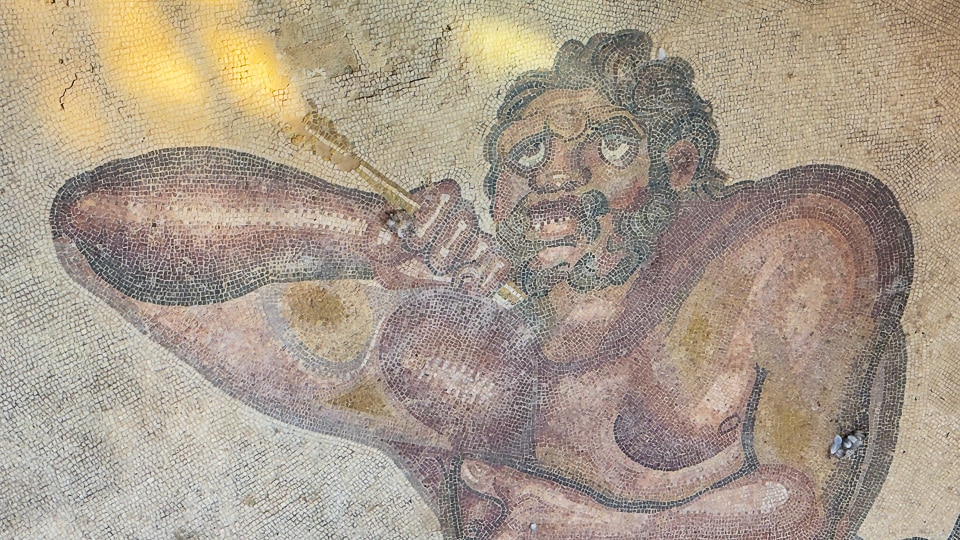
Speaking of mythology, one of the most known stories of course is that of Odysseus and the cyclops Polyphemus. If you haven’t read Homer, go see the Christopher Nolan’s The Odyssey movie. It was, though, a little odd to see Polyphemus depicted here with three eyes, including the center one. Not sure what the artist was thinking.
Arion and the Sea
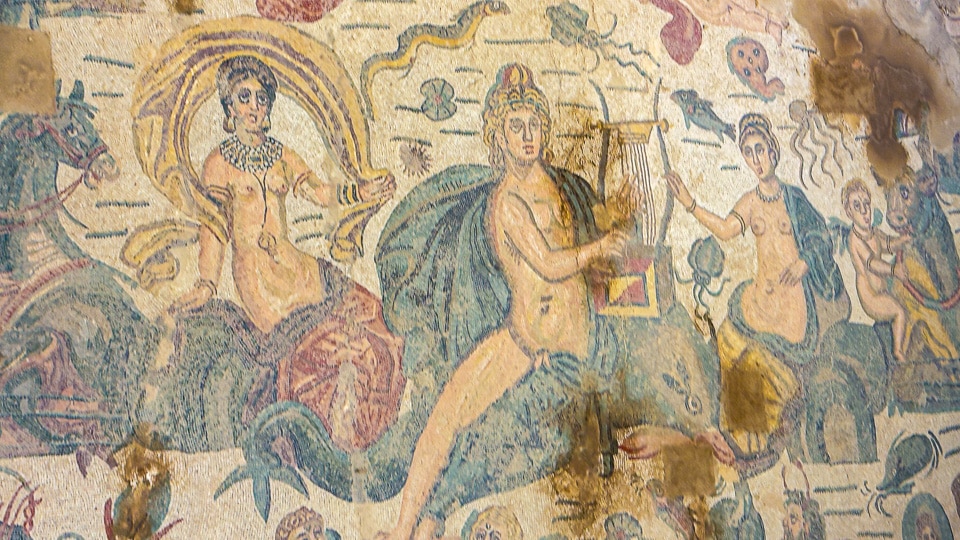
A happier myth depicted here is that of Arion, who was a prize winning poet with a definite connection to Sicily. As the myth goes, Arion traveled to Sicily for a poetry competition which he won and for which he received many valuable prizes. On his way home, his ship was attacked by pirates and Arion threw himself into the sea to avoid capture. But as he fell into the water, he sang a song to Apollo, the god of poetry and song, and the god saved him by sending dolphins to ferry him to safety. Here he’s playing to an audience of nymphs.
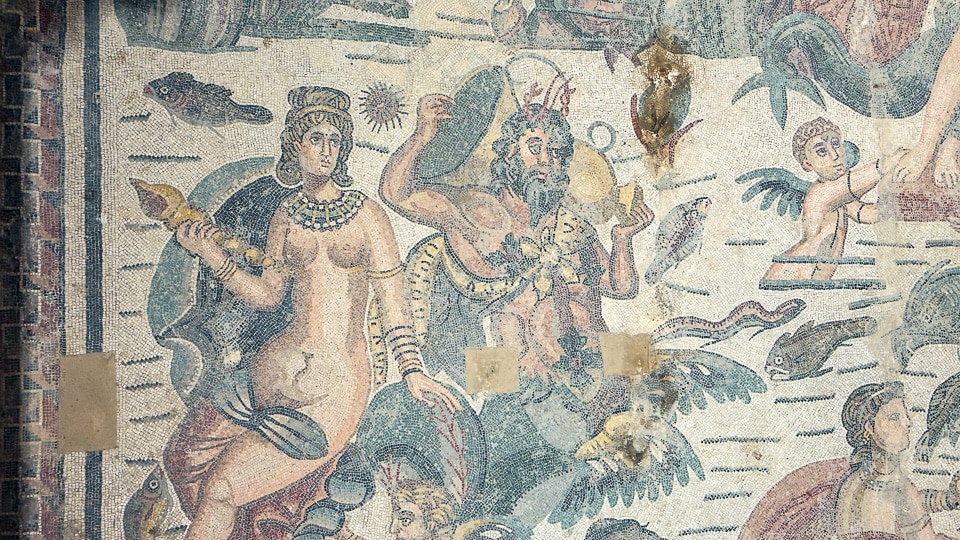
The Private Rooms
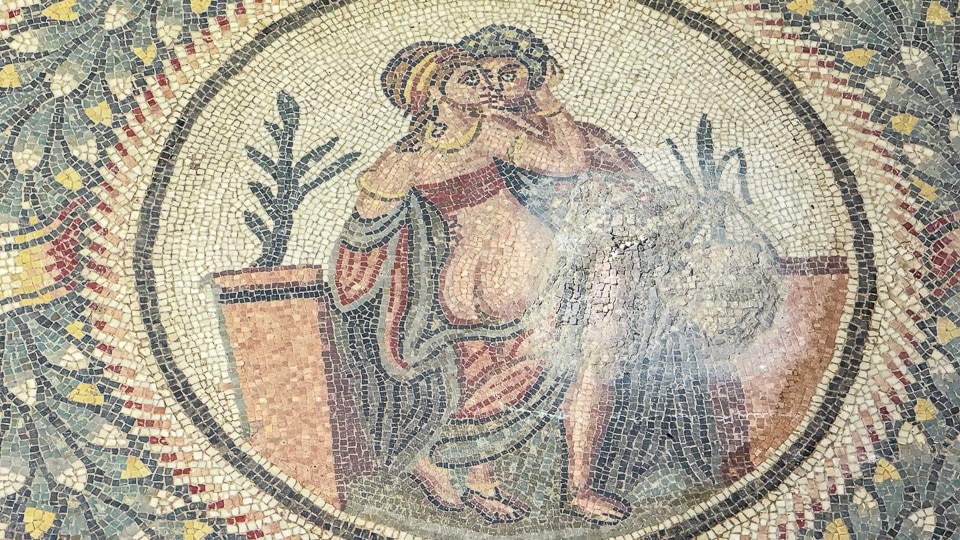
Another of the “famous” mosaics is the so-called “erotic” mosaic. This sort of decoration was frequent in Roman bedrooms, for obvious inspirational reasons.
Visiting the Villa Romana del Casale: Practical Tips
- Hours: from the end of March to the end of October the site is open from 9 a.m. to 6 p.m. Be sure to allow yourself at least two hours to appreciate it all. From the end of October to the end of March, hours are 9 a.m. to 4 p.m.
- Tickets: €14 full price, €7 reduced for EU citizens aged 18-25. Those under 18 are free, and all visits are free on the first Sunday of the month. Night visit tickets, when available, are €7. You can see current ticket info here. There is also a combo ticket available for €24 (€12 reduced) if you’re visiting Morgantina and the Archaeological Museum of Aidone (see below.) Buy the combo ticket at the first place you visit and use it at all three.
- Getting there: the villa is about 5 km south of the city of Piazza Armerina. You can drive, take a taxi, or use the seasonal shuttle (April to October). We rented a car and drove from Palermo. We stayed overnight in Piazza Armerina and drove to the site in the morning.
- Accessibility: you view everything from raised walkways. Ramps and lifts cover most, but not all, of the route. There are a few steps, and some rough ground if you walk around the grounds. Wear good shoes.
Other Things to See Nearby
The Ruins of Morgantina
Morgantina is about 15 km northeast of Piazza Armerina, the opposite direction from the villa, so plan it, along with the Aidone Museum as a separate half-day. We were easily able to see Morgantina and the museum in the morning and the villa in the afternoon.
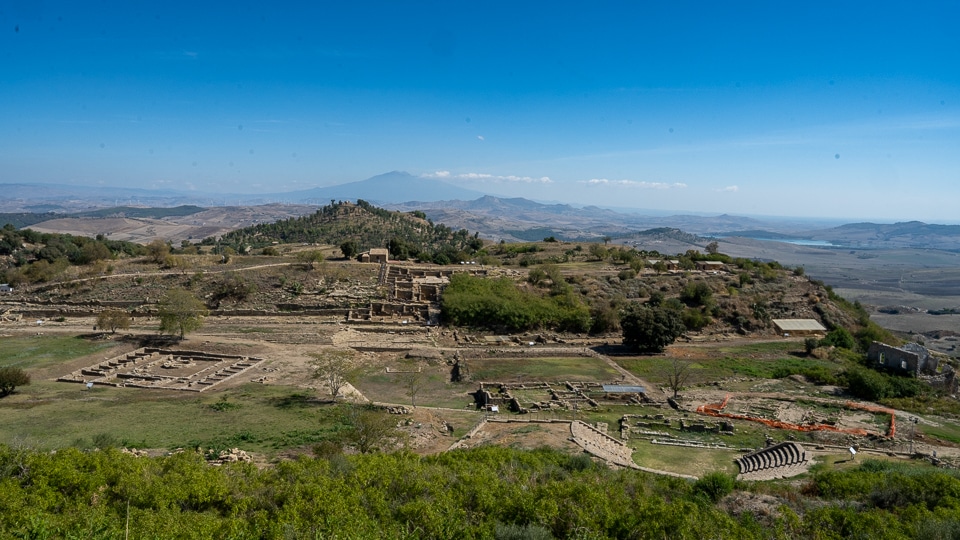
Morgantina was a Greek city on a long high ridge with views across the interior of Sicily all the way to Mount Etna. When we were there, there were only a couple of other visitors and a few small lizards scurrying about the site.
The agora, which is visible below the ridge where most of the homes stood, has a small theater, and there are the remains of Hellenistic houses, some with mosaics laid more than five centuries before those in the villa. That’s the real reason to pair the two sites: the villa shows you where Roman mosaic art ended up, and Morgantina shows you where it started. Unfortunately, the city made a big mistake and sided with Carthage against Rome in the Second Punic War and was sacked in 211 BC. Walking its empty and destroyed streets today, you can see how that went.
Allow about an hour and a half to walk the site.
The Aidone Archaeological Museum
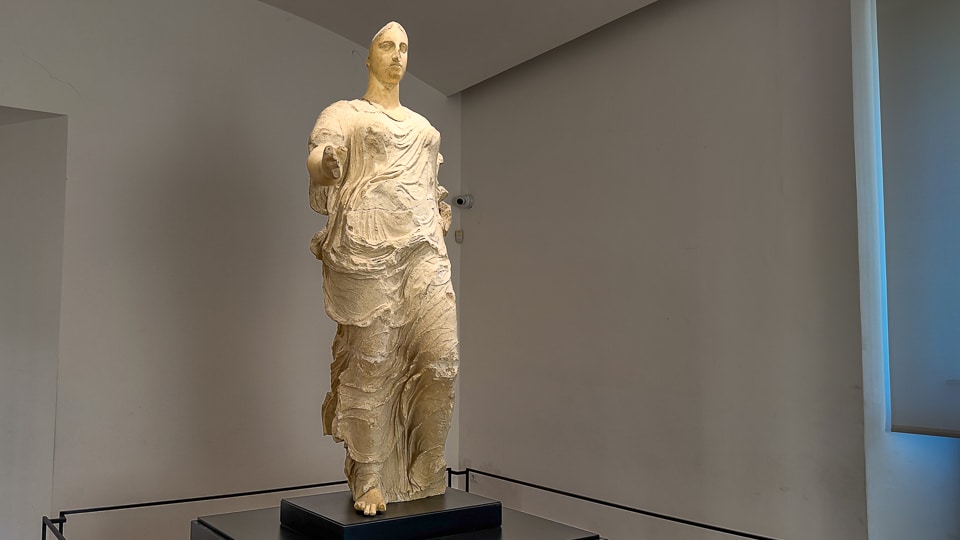
Leave time for the museum in the hilltop town of Aidone, which is on the way to Morgantina. The museum is housed in a former Capuchin convent. It holds the Morgantina site’s treasures, many of which were recently repatriated from American museums. The Goddess of Morgantina, a statue more than seven feet tall, was looted, smuggled out, and displayed at the Getty as an “Aphrodite” until Italy got her back in 2011. Marble heads of Demeter and Persephone came home from the University of Virginia. The Eupolemos silver came back from the Metropolitan Museum in New York, and a terracotta head of Hades, with traces of a painted blue beard, came home from the Getty. The museum is small enough to see in an hour, and the story behind the collection is as good as anything in it. Seeing the Goddess in the Aidone convent, a few miles from where she was dug up, feels like justice.
Where to Stay in Piazza Armerina
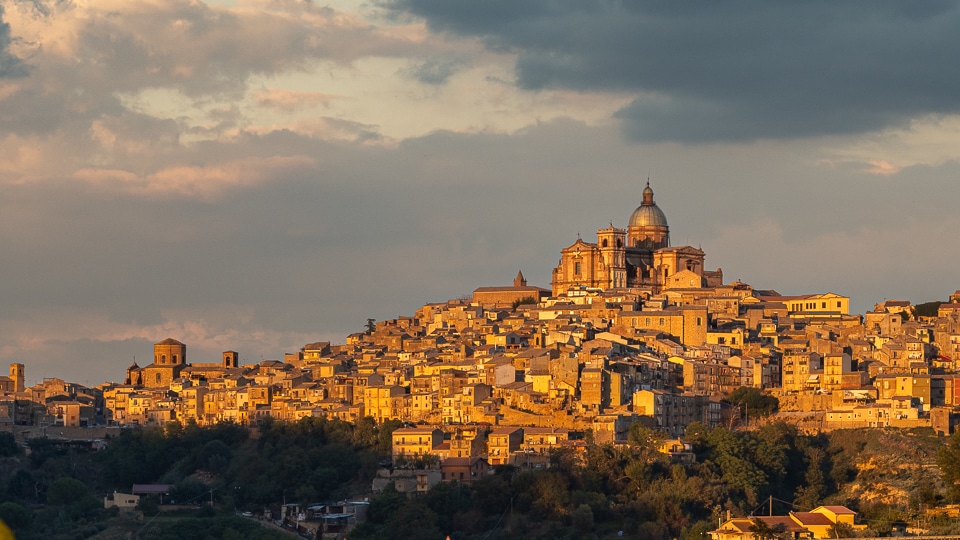
By pure luck, we stumbled upon the Panorama Suite just outside Piazza Armerina. Run by a Sicilian-Thai couple Roberto and Nicky, I can’t remember many other times in the hundreds of lodgings we have stayed in that we felt more welcomed. The drive to the Panorama Suite is a mountainside narrow rough road, but don’t let that frighten you. Once you get there, you’ll be glad you made the effort. Aside from the extremely comfortable room, there was the promised panorama of the city of Piazza Armerina, and perhaps one of the best breakfasts we’ve ever had in an inn: fresh fruit decoratively cut, homemade pastries just out of the oven, and a beautiful patio setting to eat it.
For more on Sicily, see our Guide to Palermo and our post about our visit to the stunning Valley of the Temples in Agrigento. For more on Roman history and ruins, read about our visit to Merida, Spain.
Frequently Asked Questions: Villa Romana del Casale
Is the Villa Romana del Casale worth visiting?
Absolutely. Its roughly 3,500 square meters of floor mosaics make it one of the largest collections of Roman mosaics still in their original setting, and the quality is extraordinary. It’s a UNESCO World Heritage Site, and even travelers who are lukewarm about ruins tend to be won over by the Great Hunt and the “bikini girls.”
How much time do you need at the Villa Romana del Casale?
Allow at least two hours to walk the elevated walkways and see all the major rooms. If you add Morgantina and the Aidone Archaeological Museum, plan on a full day, or better yet, stay overnight in Piazza Armerina.
How much are tickets, and is there a combined ticket?
A full-price ticket to the villa is €14, with a reduced €7 ticket for some visitors and free entry on the first Sunday of the month. A combined ticket covering the villa, the Morgantina archaeological site and the Aidone museum costs €24 and is sold at any of the three sites.
When is the Villa Romana del Casale open?
The villa is open every day, with longer hours from spring through October and shorter hours in winter. Times change from season to season, so check the official Villa Romana del Casale website before you go.
Where is the Villa Romana del Casale, and how do you get there?
The villa is in the center of Sicily, about 5 km south of the town of Piazza Armerina. A rental car is by far the easiest option; we drove from Palermo, which takes about two hours. From Piazza Armerina you can also take a taxi or the seasonal shuttle that runs from April to October.
Is the Villa Romana del Casale accessible for people with limited mobility?
Mostly. You view the mosaics from raised walkways under a protective roof, and ramps and lifts cover most of the route, though not all of it. There are a few steps and some rough ground outside, so wear sturdy shoes.
What are the “bikini girls” at the Villa Romana del Casale?
They’re the villa’s most famous mosaic, in the Room of the Ten Maidens. It shows young women in two-piece outfits competing in athletic events, including weightlifting, discus throwing, running and ball games, and receiving crowns and palm fronds as prizes.
Is it worth visiting Morgantina and the Aidone museum too?
Yes. Morgantina is a Greek city with a theater and an agora, and its houses have mosaics that are centuries older than the villa’s. The Aidone museum holds the Goddess of Morgantina and other treasures returned from American museums. Both are a short drive northeast of Piazza Armerina.
Who owned the Villa Romana del Casale?
No one knows for certain. The leading theory is that it belonged to the co-emperor Maximian, though some scholars favor a wealthy senator. Whoever it was could afford the best mosaic artists in the empire.