
A week (or a month) at a language school abroad is the single best slow-travel investment you can make after 50 — for your brain, your friendships, and the depth of every trip that follows. Here’s how we’ve done it.
When Kris and I came to Spain for the second time in early 1978, we were determined to stay for a while. That might have been a bit backwards from most people’s thinking as, to that time, we’d only had a few weeks introduction to Spain in 1975 as part of a post-college combo hitch-hiking (remember that?) and train trip around most of western Europe.
We were in our early 20s then, had no particular responsibilities, and had enough money saved that we didn’t have to work for a few months. So, Spain? Why not?
The first thing we did was enroll in two months of intensive Spanish classes in Barcelona. Those were followed by one month living in a small village as the only foreigners and then another month of intensive classes in Madrid. At the end of that time, we were, shall we say, “proficient” in the language. We ending up spending almost two years in Spain, and naturally got even better.
Since then, when our intervening career as publishers permitted, we’ve been back to Spain probably dozens of times. But, even with intermittent practice over the years, and living in South America for a year, I admit to becoming less fluent, particularly in hearing it. Spanish speakers tend to speak extremely rapidly. The language’s structure of vowel, consonant, vowel, consonant, vowel allows for almost infinite elision, and that means speed.
As one friend just said about Spain, “How do they talk so fast and walk so slow?”
Why Take a Language Class While Traveling
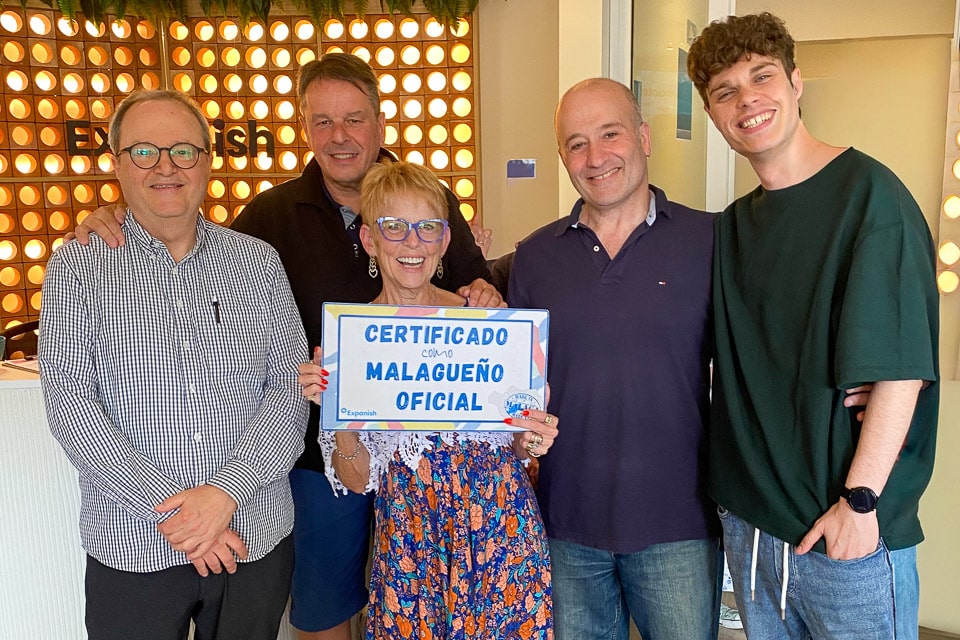
Earlier this month, Kris had been offered a one-week press trip to drink Sherry in Jerez in southern Spain, and as usual when that happens to one of us, the other tags along and finds something else to do with that time. I looked around a bit for something in southern Spain that I could do for a week, and luckily came up with a one-week class specifically designed for those of us over 50. And it was in Málaga, which also happens to be one of my favorite cities in Spain. I ended up with a 50+ class with Expanish, which exactly fit our schedule.

After I signed up, Expanish arranged about a 15 minute video call to establish my fluency level a couple of weeks ahead of the start date, and then we were set.
A week of classes in a Spanish city is a great idea on several levels: first, it puts you in contact with a local teacher and school staff who know the city intimately. This is particularly useful for finding non-touristy restaurants. Second, you meet fellow students who become instant travel companions to visit those restaurants with. And, third, you settle into a daily structure that makes you feel a little more like a resident than a tourist. You’re not just learning vocabulary and grammar. You are learning something about how a place thinks and works.
Planning a broader trip to Spain? Our Spain Travel Guide for Travelers Over 50 covers everything from Madrid to Andalucía, with tips on trains, food, itineraries, and slow travel.
It’s my belief that over-50 travelers are well-suited to language learning abroad. You probably have more patience than you did at 30. You’re less self-conscious about making mistakes. You have almost certainly built up more context for culture, history, and food than you had at 25 — and that context makes the language stick.
There’s a reward at the end, too. Even a week of classes should give even a rank beginner enough vocabulary and courage to order off the menu, ask for directions, chat a little with a shopkeeper, and navigate a city without defaulting to English. That small shift changes your entire experience of a place. Not the least of which is that the locals respond differently. Opening a conversation with “Buenos dias” instead of “Do you speak English?” works wonders. Even if you eventually have to switch to English, believe me, you’ll be treated much better by everyone you run into.

Language learning is also a great excuse to stay in Spain, or anywhere else, longer. This is the essence of slow travel. Signing up for a one or two-week language course is a built-in reason to base yourself somewhere long enough to actually know it. It solves the “how long should we stay?” question for people who sometimes struggle to give themselves permission to slow down and really get to know a place.
Of course you can combine your language learning in Spain with more lessons at home. Consider brushing up between visits. Beyond making travel easier, there are plenty of benefits of learning a language later in life, keeping your mind sharp and your worldly interests in focus.
What a Week of Classes Actually Looks Like
Expanish’s class fulfilled all my expectations, on several levels. Although my level of Spanish was far above that of my classmates, it was still a good review, and it was four hours a day of hearing our excellent teacher Gabriel López speaking Spanish at near native velocity. And while he was teaching what was for me elementary grammar, he did it without necessarily using elementary-level language. So, for most of the other students, they were getting not only the grammar and vocabulary lessons at their level, but also got to hear colloquial-speed Spanish – with the subjunctive and all. There’s learning there by osmosis.
If you’re interested in learning the language in a Spanish setting, Expanish is an excellent choice for a few reasons. First, and probably most important, is that they only teach Spanish to foreigners, unlike many schools who also teach other languages to Spaniards. That focus is key, in my opinion. Second is their methodology. I have taught English as a foreign language for about three years and I have a certificate from Cambridge University in language teaching, so I’m fairly versed in the various methodologies of language instruction. Expanish’s method, especially as practiced by Gabriel, was perfectly suited to a 50+ learning style. His organization of the lessons was exemplary. In general, he’d give us a grammar point and some vocabulary, then he’d break the class of nine of us into small groups of two or three people and had us actually ask each other questions according to prompts he’d handed out. It went back and forth – questions and answers – designed to drill in the grammar and vocabulary he’d just taught. And, speaking and listening is the best way to learn a language.

Another aspect of the Expanish experience I loved was they took us on “field trips” to a beachside paella restaurant, the Málaga Museum, the Málaga Cathedral, and a Flamenco show at an intimate club. While the restaurant and Cathedral resulted in a little more English being spoken than I would have liked, and the Flamenco show was the ultimate Andalucian cultural touchstone, the museum visit was augmented by a little “scavenger hunt” that forced the students to find certain works and themes, and then submit to a bit of questioning at the end of the tour where they had to explain, in Spanish, what they’d seen. All three experiences, of course, just enhanced the experience of Málaga’s cultural richness.
In general, language schools attract an interesting assortment of people. First, by definition, a school attracts curious long-term learners — retirees, vacationers and current or prospective expats who are more fun to be with than the tourists who wander around foreign cities searching for a McDonalds. For solo travelers especially, showing up somewhere with a built-in structure removes one of the biggest anxieties of slow travel. You have somewhere to be every morning and people to hang out with in the evenings.
My class was a particularly interesting mix of people. First, the nine people came from six different countries, and English was not necessarily the default common language. There were a whole lot of German, French, and Brazilian Portuguese accents in the class. So, honestly, except for the four native English speakers in the class, the common language was…Spanish.
And, there was not just a diversity of nationalities. Among our group were business people, engineers, writers, and even an opera singer who had performed at the Met! What a great group.
So, if that sort of thing appeals to you – and it should – you ought to have a look at various educational opportunities in foreign countries. We’ve only had experience with Expanish and Elective Study Abroad, and can heartily recommend both. In fact, we’re doing another Elective course in Spain this fall in Granada and Córdoba. By the way, Expanish also teaches in Buenos Aires, Argentina, and Madrid and Barcelona in Spain.
You certainly don’t have to limit yourself to Spain. Most countries have language schools that specifically cater to foreigners. If you’re using a search engine, be sure to use specific language, e.g “Spanish schools for adults in Málaga,” or “Spanish immersion for adults 50 plus.”
How to Find a Good Language School Abroad
Some Accreditations to Look For
Another useful bit for finding a school is knowing the “official” accreditation and organizations known for the language you’re interested in. Here are a few we know of:
- Instituto Cervantes accreditation (Spain/Spanish;)
- EAQUALS membership — a European accreditation body for language schools worth knowing;
- Alliance Française (French) — a global network of French language schools with consistent quality standards;
- Goethe-Institut (German) — same idea; the gold standard for German language instruction worldwide;
- British Council — for English, but also a useful quality benchmark in countries where they operate language programs;
- For Italian, you want schools affiliated with the Società Dante Alighieri.
Questions to Ask Before You Sign Up
Once you’ve identified a potential school, be sure to quiz them about things that are important to you. For example:
- What is the average class size?
- What is the age range of students in adult programs?
- Do you offer placement testing before the course begins?
- Can I speak with a past student?
Furthermore, ask some of the following questions:
- Ask specifically about the class size that you’d be in. The difference between six students and fifteen is enormous. Eight or fewer is ideal for real conversational practice.
- Ask about teacher qualifications. You want native speakers with formal ELE (Español como Lengua Extranjera, at least in Spain) or equivalent teaching credentials — not just fluent speakers.
- Does your school offer homestay or apartment placement alongside classes — a signal that they are set up for serious immersive learners rather than casual drop-ins. Expanish does, btw.
- Check when the school was founded. A school that has been operating for 15 or 20 years in the same city has survived on reputation. New schools may be excellent but carry more risk.
The Brain-Health Benefits (And What the Research Says)
Finally, one more reason why you should consider an educational opportunity as part of your travels is that there is solid research on language learning and brain health in older adults. Learning a new language is one of the most effective things you can do for cognitive resilience.
The effectiveness of language learning as a cognitive intervention is influenced by the intensity and duration of the learning experience. A two-week immersive course is likely more beneficial than a casual app habit — which is why you should take a proper class abroad rather than dabble with Duolingo at home.
An immersive language course abroad is one of the most effective ways to get those benefits, because you are not just studying the language. You are living it.
Staying smart requires practice.
FAQ
Is it too late to learn a language at 50 or 60?
Absolutely not. While it’s probably true that “younger” minds soak up language faster by hearing it, an experienced learner will make much more sense of logical building blocks of grammar, and will be able to construct an understanding of how the language works relatively quickly. Research also shows that language learning in older adults stimulates neuroplasticity and supports cognitive health.
How long should I take language classes abroad?
Obviously, more is better. If I were starting a language today, I’d take at least two weeks – and preferably a month – to get a good start. If you already have some of the language, even one week will increase your skills a lot.
How much does a week of Spanish classes in Spain cost?
For Expanish in Málaga, the fees for the 50+ program are currently are €325 for one week and €585 for two weeks. Prices vary by school and city, but this is a representative range for quality adult immersion programs in Spain.
Do I need to know Spanish before signing up for a class in Spain?
Not at all. Most reputable language schools, including Expanish, offer courses at all levels including complete beginners. Schools typically conduct a brief placement assessment before you start to match you with the right class.
What’s the difference between Expanish, Instituto Cervantes, and a university program?
Expanish is a communicative, immersive program with small class sizes (usually 8-10 students maximum), flexible start dates, and a focus on real-life conversational skills. Instituto Cervantes is the official Spanish government language institution — expect more academic rigor and a formal approach. A university program will vary by institution but typically involves more reading and writing and less conversational practice. For travelers over 50, Expanish’s approach tends to be the best fit.
What cities does Expanish teach in?
Expanish operates in Málaga, Madrid, and Barcelona, Spain, and Buenos Aires, Argentina. Málaga is particularly well suited to slow travelers who want to combine language learning with exploring Andalucía.
What should I look for in a language school abroad?
Key things to look for: small class sizes (eight or fewer is ideal), qualified native-speaker teachers with formal language-teaching credentials, placement testing before the course begins, accreditation from a recognized body such as Instituto Cervantes (Spanish), Alliance Française (French), or Goethe-Institut (German), and a school that has been operating for at least 10-15 years. Ask to speak with a past student before booking.
How do I book Expanish classes?
Obviously, have a look at Expanish’s website and make sure it’s the program for you. Once you’re convinced, you can actually book right at this page. Expanish conducts a brief video call placement assessment a couple of weeks before your start date to ensure you are placed in the right level.