
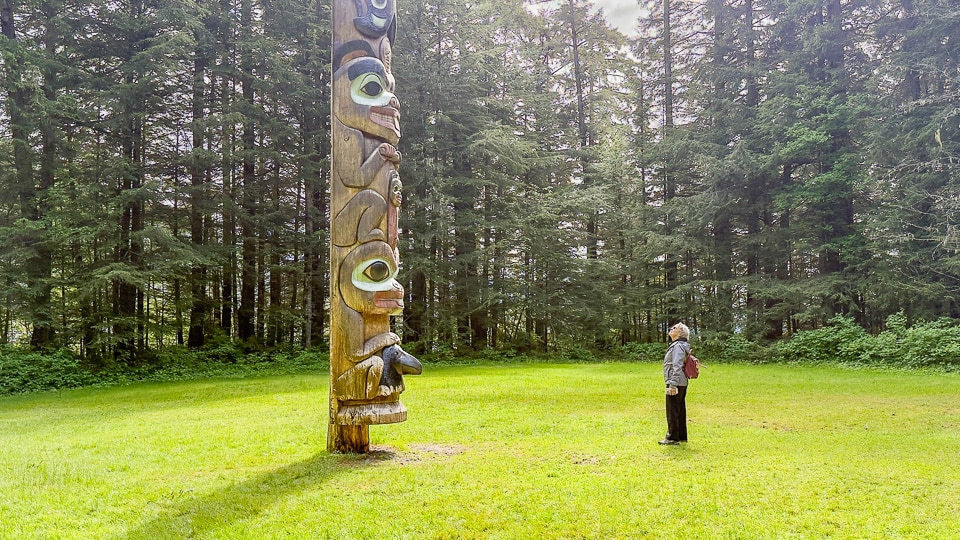
Until recently, Alaska was the one state Kris and I had not visited. So when we finally made it to the Inside Passage with American Cruise Lines’ Alaska Explorer Cruise, Sitka was clearly an important stop. Sitka National Historical Park turned out to be one of the most quietly remarkable places we’ve been in the entire National Park system.
Sitka National Historical Park doesn’t have the dramatic scale of many of the National Parks we’ve visited. But what it does have is perhaps something rarer: a small, walkable park where layers of Indigenous, Russian, and American history enthrall you from all sides as the astonishing totem poles rise out from the luminescent green rainforest, and are accented with the subtle burble of the salmon river just beyond the trees.
Note: We’ve also written about the cruise ship itself and our Inner Passage excursions in the post, “Sailing Alaska’s Inner Passage: The Small Ship Cruise Experience.” You’ll find more Tlingit history – and the story of the Little Ice Age – in our related post, “Glacier Bay National Park: Ice, History, and the Tlingit People.”
What Is Sitka National Historical Park?
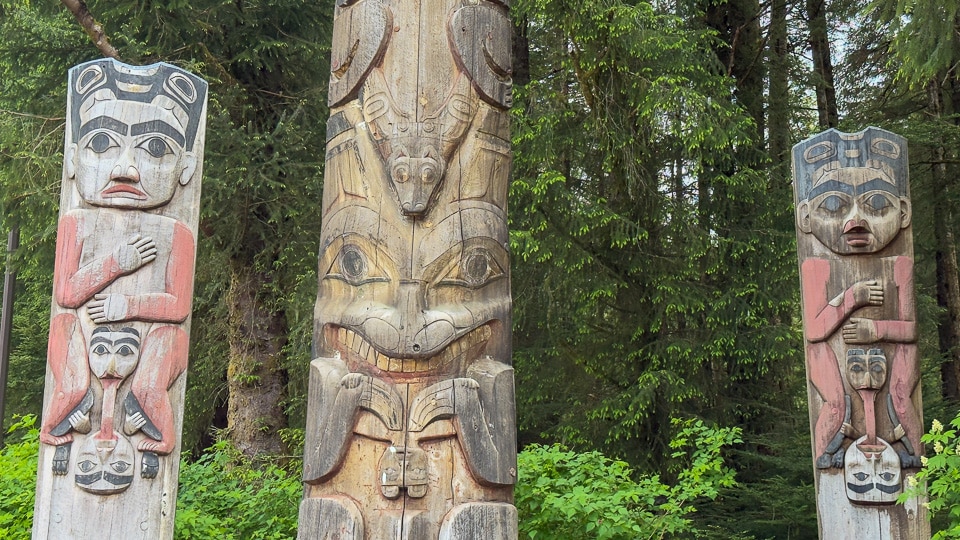
Sitka National Historical Park is Alaska’s oldest federally designated park. It was established in 1890 as a public park by President Benjamin Harrison. It was named as Sitka National Monument in 1910 by President William Howard Taft, and was expanded and redesignated as Sitka National Historical Park in 1972. At just 113 acres, it is also the smallest national historical park in Alaska. Consequently the park is supremely manageable. This is a park that rewards slow exploration, which probably will take no more than two hours.
The park sits at the mouth of the Indian River on Baranof Island in Southeast Alaska, just a 20 minute walk from downtown Sitka. It was created to commemorate the 1804 Battle of Sitka, a pivotal clash between the Tlingit Kiks.ádi clan and the Russian-American Company that marked the end of major Tlingit resistance to Russian colonization. Over the decades the park has grown into a living repository of Tlingit and Haida culture, centered on one of the most important collections of totem poles in the world.
The History Behind the Park
The Kiks.ádi clan of the Tlingit people had lived on this stretch of Baranof Island for roughly 11,000 years. They were skilled hunters and traders, especially of sea otter furs. When Russian fur traders arrived in Alaska in the late 1700s, the Tlingit people initially welcomed limited trade.
But Russian ambitions soon outpaced Tlingit tolerance. The Russian-American Company built a large fortified settlement at Sitka in 1799, exceeding what the Tlingit chief had agreed to. By 1802, relations had collapsed entirely and the Tlingit attacked and destroyed the Russian fort, driving the colonizers out.
The Russians returned in force in 1804. Led by Alexander Baranov and supported by Russian Imperial Navy gunboats, they confronted the Tlingit at a defensive fort the Kiks.ádi had built at the mouth of the Indian River — a structure they called Shís’gi Noow, or Sapling Fort. After six days of bombardment, the Tlingit slipped away under cover of darkness, walking all the way to Chichagof Island in the middle of winter. They didn’t return to the area until the 1820s.
After their victory, the Russians built a new colonial capital on the site, which they called New Archangel. It remained the capital of Russian Alaska until the United States purchased the territory in 1867. The Russian Orthodox Bishop’s House is the oldest intact Russian building in Sitka and still stands today as part of the park.
The Visitor Center: Start Here
The visitor center is the natural first stop for your park visit, and it’s worth spending some time here before heading out to the trails.
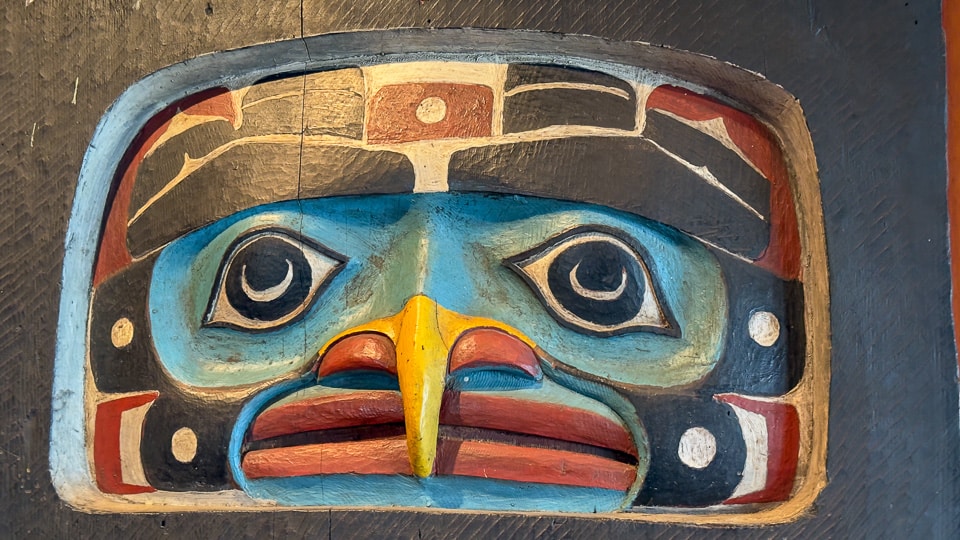
The building was constructed in 1965, and was designed to evoke a traditional Tlingit clan house with heavy support beams, a low-sloping roof with the gable oriented toward the water, and Alaska Native carvings throughout the interior. Carved house posts and a Tlingit decorative screen anchor the open floor plan.
Inside, there are ethnographic displays of traditional Tlingit life including bentwood boxes (which the Tlingit used for cooking fish), spruce root baskets used for storage, drums, robes, and ceremonial objects. The collection includes didactic panels that give cultural and historic context.
There’s also a small theater showing a 12-minute film called The Voices of Sitka, which weaves together multiple perspectives on the park’s history. It’s worth taking the time to watch if you’re new to the story of Sitka.
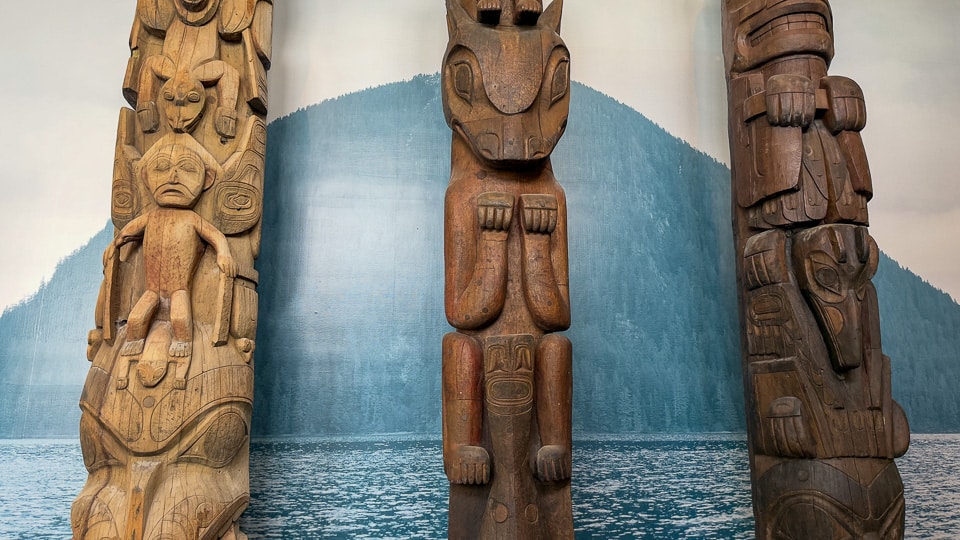
Totem Hall is the highlight of the visitor center. Several of the original totem poles are too fragile or deteriorated to remain outside and are preserved and displayed here. Seeing them up close, out of the elements, gives you a different appreciation for the carving skill of the artisans who made these, usually more than 100 years ago.
The Southeast Alaska Indian Cultural Center operates within the park and has three artist studios where Alaska Native artists work and demonstrate their crafts during the summer months. On our visit, we watched a teacher working with a young carver molding wide planks of yellow cedar into a bentwood box drum. If you’re lucky, you can also watch beading, spruce root weaving, and metal engraving. This isn’t a performance for tourists. These are working artists keeping traditions alive by teaching the next generation.
Ranger-led talks also happen regularly from the visitor center porch, covering topics including the totem poles, the park’s history, and Southeast Alaska natural history. Check the schedule when you arrive, or look it up in advance at the Park’s website.
The Totem Trail: A Walk Into Tlingit Art and History
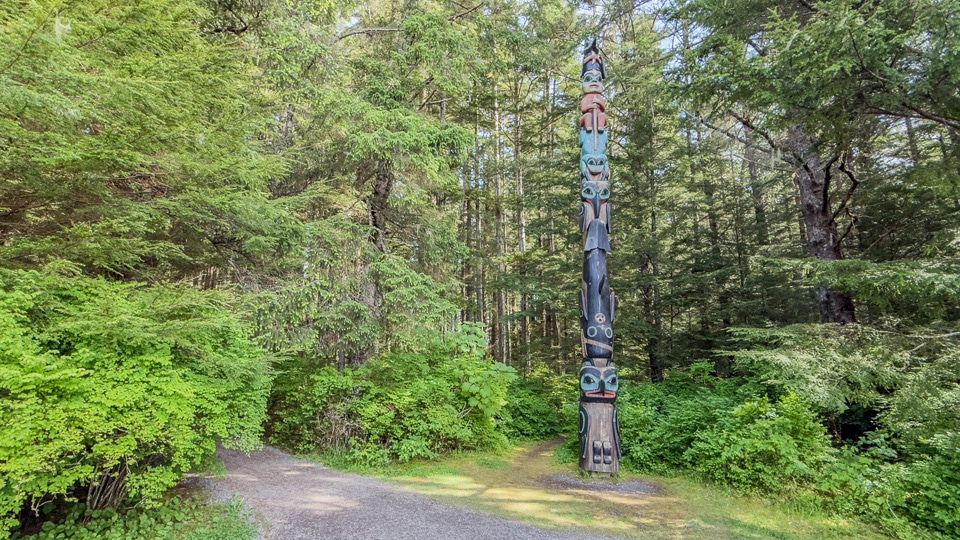
The Totem Trail begins just behind the visitor center and loops for about a mile through temperate coastal rainforest. The trail is flat, well-maintained, and accessible. Expect to spend an hour or more if you stop to read the interpretive signs and take photographs – which you will. We certainly did.
The forest itself is extraordinary. Giant Sitka spruce and western hemlock tower overhead and the understory is thick with moss and fern. The Indian River runs alongside part of the trail. In season, it’s a salmon stream, and you can stand on a small arched footbridge and watch the fish below. Bald eagles are a constant presence, as are vociferous ravens, one of whom sat on a low branch and squawked at us for several minutes. You don’t know how big ravens are until you see one up close.
The park is also home to brown bears, deer, river otters, and mink – reminders that this is wild Alaska, even a short walk from downtown Sitka. We saw plenty of evidence of bear on the trail, and while we were in the visitor center, a breathless tourist came in to tell the ranger on duty that a bear was on the bridge very near the center.
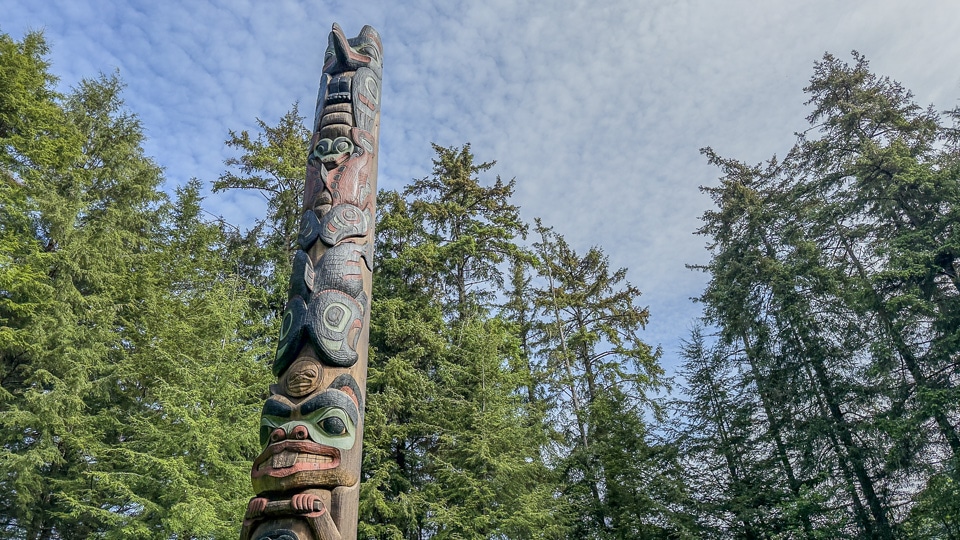
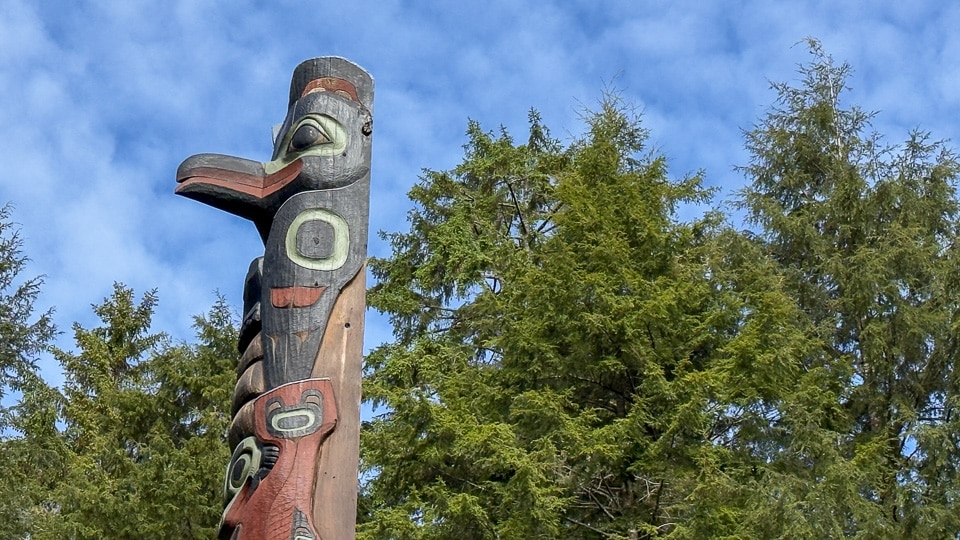
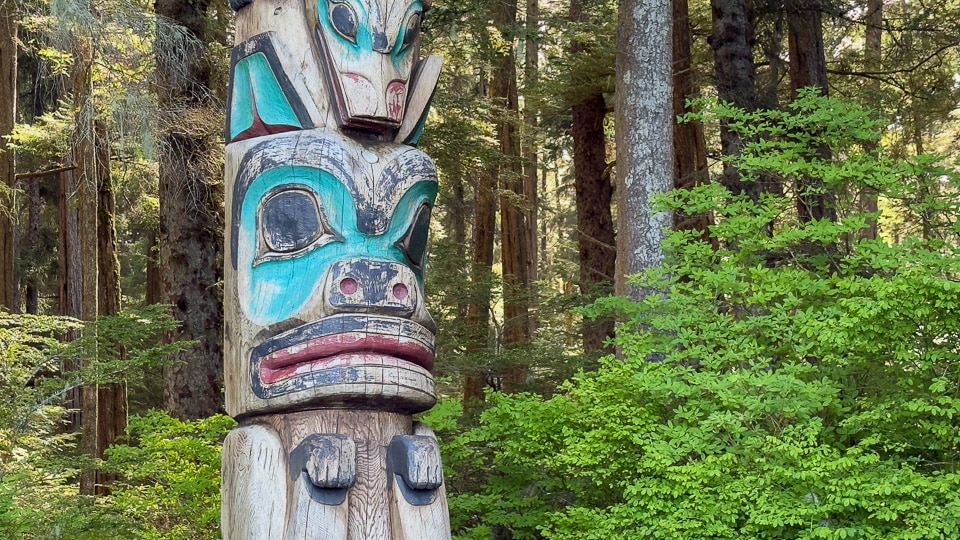
Then there are the totems. There are approximately 18 to 20 poles along the trail. The number fluctuates as reproduction poles are added and fragile originals are moved indoors. Each one stands in a small clearing of its own, surrounded by trees, facing the water where possible. Walking among them engenders a constant sense of amazement at how distinctive they are, and at the same time, well fitted into the natural environment.
How to Read a Totem Pole
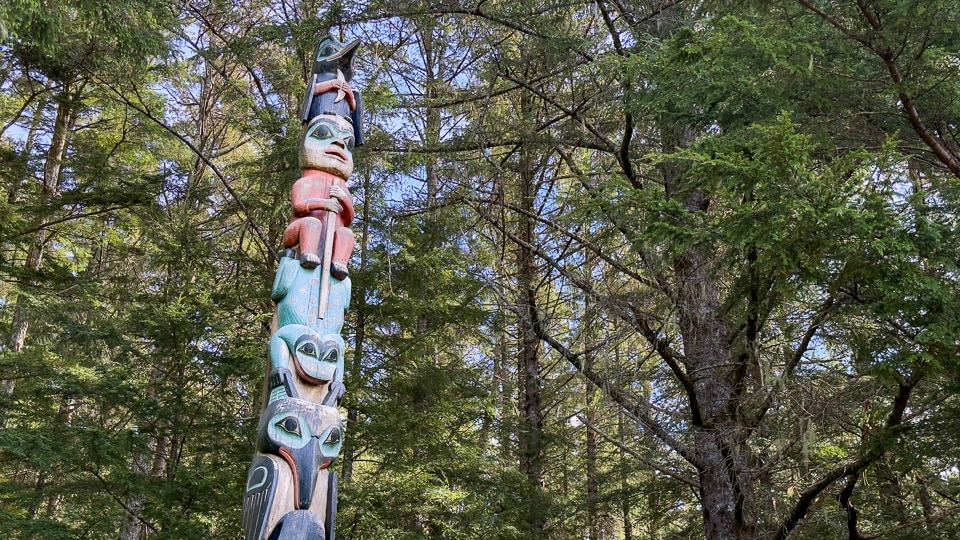
Before you go, it helps to understand what you’re looking at. Totem poles are not religious objects and are not meant to be worshipped. They are narrative and commemorative structures. The Tlingit and Haida used them to serve four main purposes:
- Crest poles record the ancestry of a particular family or clan
- History poles tell the story of a significant event in a clan’s history
- Legend poles illustrate a piece of folklore or a real-life experience
- Memorial poles honor a specific individual
The figures on the poles — bears, ravens, eagles, frogs, beavers, salmon, humans — are clan crests: animals or figures associated with particular families. Reading a pole requires cultural knowledge that I certainly lack, which is why the ranger-led walks are so worthwhile. But even without that context, the scale and artistry are affecting.
A Note on the Poles’ History
The collection has an unusual backstory. Most of the original poles were not from Sitka. In 1901, Alaska’s territorial governor, John Brady, gathered totem poles from Tlingit and Haida villages throughout Southeast Alaska to represent Alaska at the 1904 St. Louis World’s Fair and the 1905 Lewis and Clark Exposition in Portland. Brady secured donations from villages across the region — a remarkable achievement, as collectors and curators had long been refused.
After traveling roughly 6,000 miles by ship and rail, the poles returned to Alaska in 1906 and were installed along what would become the Totem Trail. Over the following decades, they weathered and deteriorated. New Deal employment programs in the 1930s and 40s hired Alaska Native carvers to repair and replicate them, beginning a tradition of ongoing stewardship that continues today. Several poles you see on the trail are second-generation reproductions of originals now held in Totem Hall; others are more recent commissions.
Poles to Look For
The K’alyaan Pole is one of the most significant in the park, directly connected to the landscape around you. Standing 35 feet tall and carved from red cedar, it was erected in 1999 as a memorial to the Tlingit Kiks.ádi clan members who died defending their homeland in the 1804 Battle of Sitka. At the base, a carved raven helmet commemorates K’alyaan, the warrior leader who wore that helmet into battle. The frog figure holding the helmet is another Kiks.ádi crest. Higher on the pole, the crests of allied clans — beaver, dog salmon, sockeye salmon, woodworm — appear in their honor. The pole was carved by Tlingit artist Tommy Joseph and given to the National Park Service by the Kiks.ádi clan in memory of their ancestors. K’alyaan’s actual war hammer is on display inside the visitor center.
The Battle of 1804 memorial site is at roughly the midpoint of the trail: a grassy clearing with a commemorative plaque dedicated in 2011. This is where the Tlingit Sapling Fort once stood. Nothing physical remains of the fort, but standing in that open field among the trees, the events of October 1804 feel close. In summer, rangers lead daily Battle Walks from the visitor center. If one is scheduled during your visit, take it.
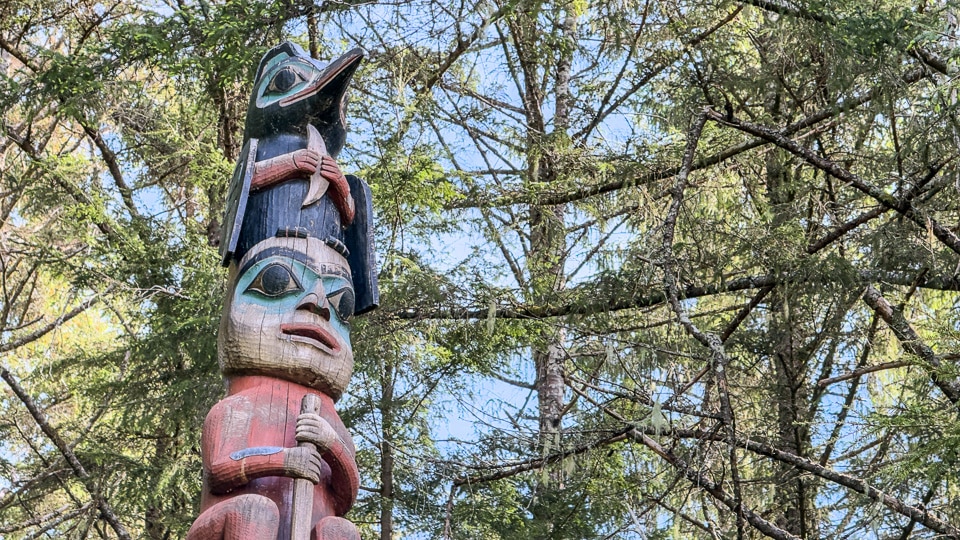
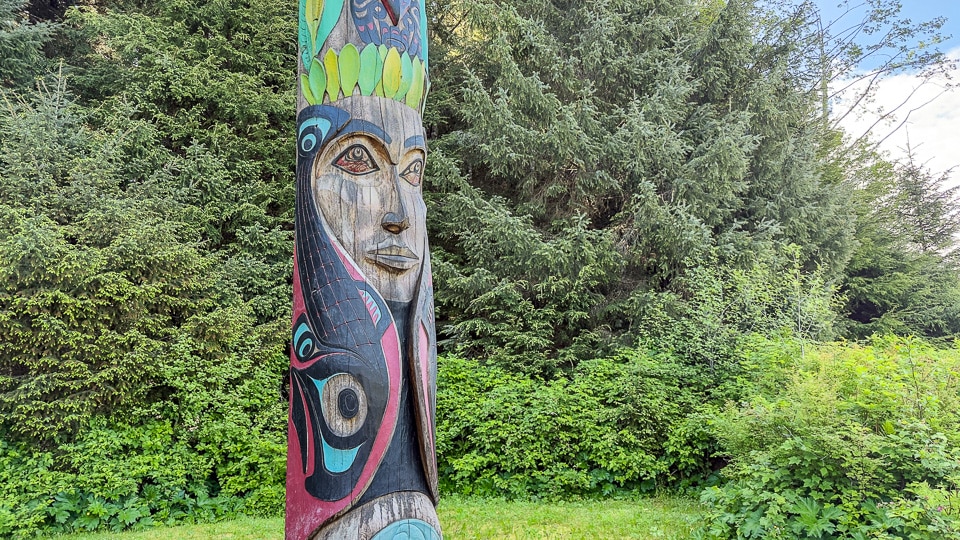
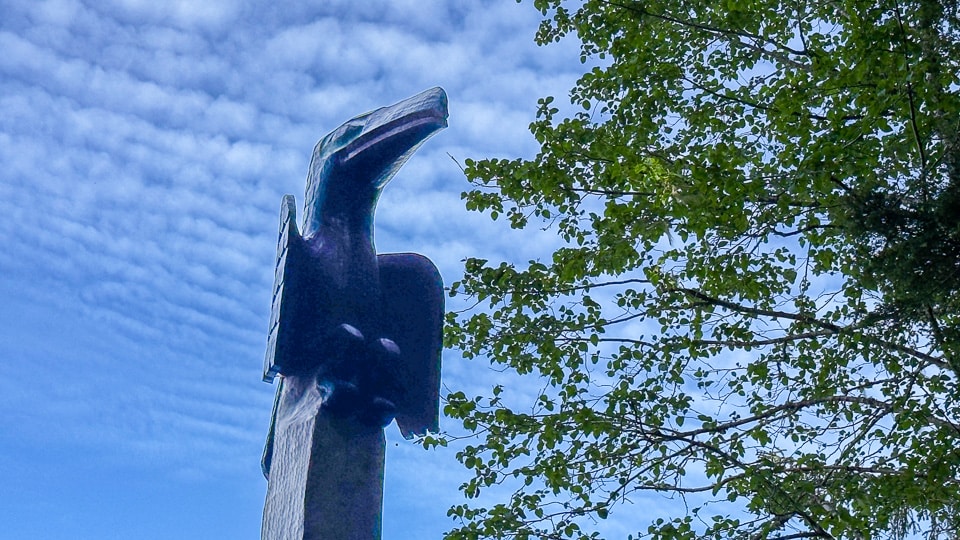
The Raven poles appear in multiple forms throughout the trail. The raven is one of the two primary figures in Tlingit society — along with the eagle, it represents one of the two great moieties that structure Tlingit social life. Traditional Tlingit society required that a Raven marry an Eagle, and vice versa. When you understand this, the poles begin to tell a social story as well as a narrative one.
The Centennial Pole is the newest addition, dedicated on May 15, 2011 to mark the park’s 100th anniversary. Near the top you’ll find an interlocked raven and eagle draped with a centennial Ravenstail robe — a totem that honors both Indigenous tradition and the park’s own history.
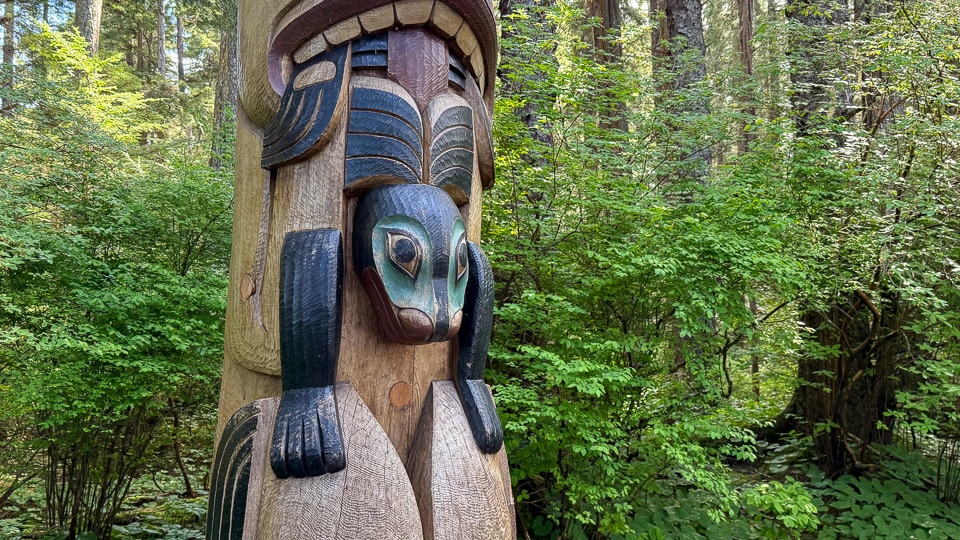
The Waasgo Pole tells a Haida legend rather than a Tlingit story. The Waasgo is a sea monster in Haida tradition and a reminder that the collection draws from multiple cultures across Southeast Alaska. Master carver Tommy Joseph completed a new reproduction for the trail as part of the park’s ongoing effort to restore the full historic cultural landscape.
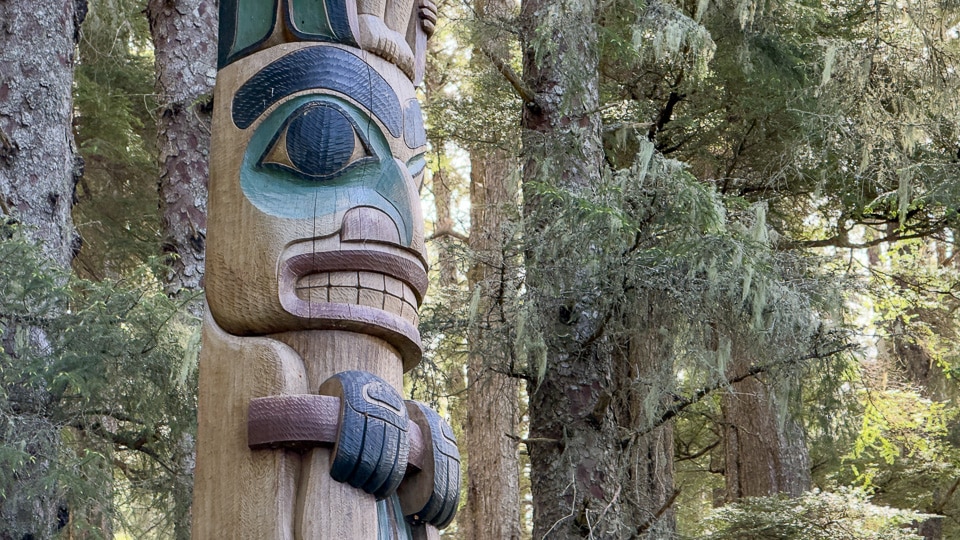
Bear figures appear on several poles throughout the trail. Bears are among the most common clan crests in Tlingit and Haida carving, associated with strength and specific family lineages. The “Bear Mother” story — the legend of a woman who married a bear — appears in various forms across the collection.
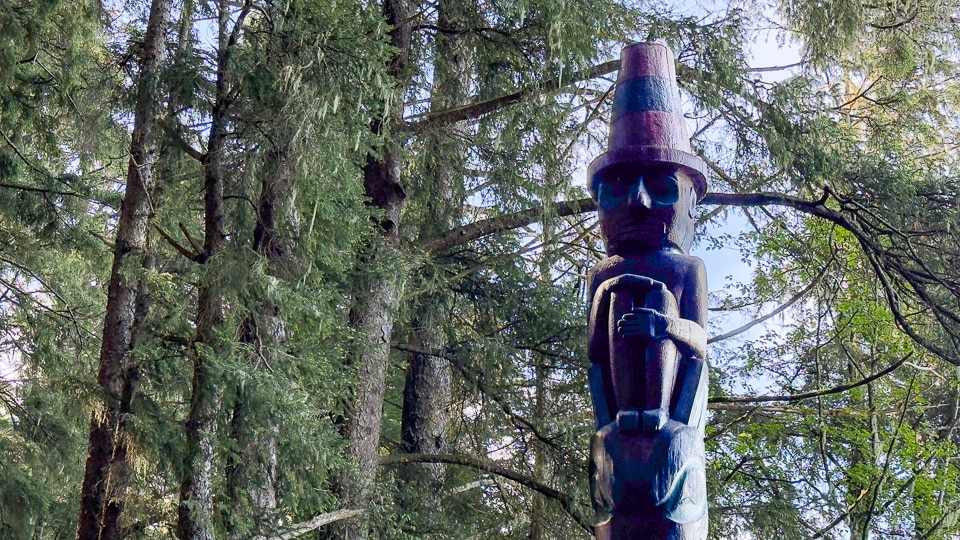
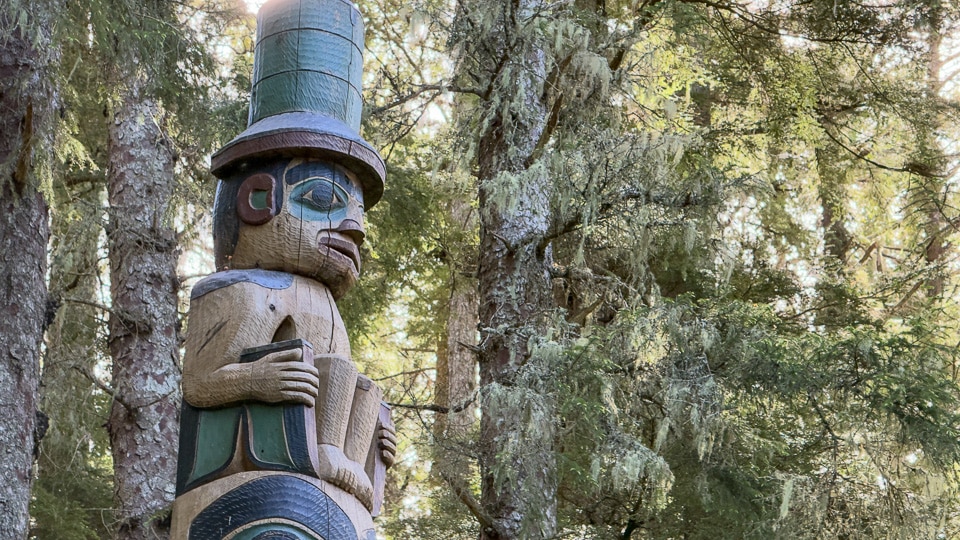
The hat-figure pole is one of the more memorable encounters on the trail — a slim dark pole rising above the canopy topped by a human figure wearing a top hat. The top hat became a status symbol among Northwest Coast peoples after contact with European and American traders; these figures typically represent a chief or person of high standing.
The Russian Bishop’s House
Part of the park, though located closer to downtown Sitka, is the Russian Bishop’s House — the oldest intact Russian building in Alaska. Built in 1842, it served as the residence of the Bishop of the Russian Orthodox Church in Alaska and is now a National Historic Landmark.
The National Park Service has restored the interior to its mid-19th century appearance. The chapel on the upper floor still contains original furnishings and iconostasis. Ranger-led tours are available in the summer. It’s a fascinating complement to the natural and Indigenous history in the main park — a tangible remnant of the Russian colonial period whose legacy is still felt in Sitka today through the Russian Orthodox community that remains active in the city.
Practical Information
Location: 103 Monastery Street, Sitka, Alaska. The park is an easy 15–25 minute walk from downtown Sitka and from the main cruise ship docks. City buses stop at the visitor center’s upper parking lot hourly.
Entrance fee: Free. No reservation required.
Hours: The park grounds are open year-round for day use. The visitor center hours vary by season — check nps.gov/sitk before you go.
The trail: The Totem Trail is flat, well-maintained, and accessible. Plan about an hour for a relaxed walk, more if you want to read every interpretive sign or wait for the light on a totem you want to photograph.
Wildlife: Brown bears are active in the park year-round, including near the visitor center. Keep your distance and pay attention. More than 150 bird species have been identified in the park. Bald eagles and ravens are common.
Getting there: Sitka is accessible by Alaska Airlines flights, Alaska Marine Highway ferries, and as a port of call on Alaska Inside Passage cruises. If you’re on a cruise, the park is walkable from the tender dock and is one of the best uses of your time in port.
Best time to visit: Summer (June–August) offers the best weather, the most ranger programming, and the best chance of seeing the Southeast Alaska Indian Cultural Center artists at work. That said, the park is open and beautiful year-round — fall can be stunning, with salmon in the river.
Bring: Rain gear. This is a temperate rainforest. Even a sunny morning can turn damp. Layers are always right in Southeast Alaska.
We’ve visited a lot of national parks, and Sitka remains one that stays with us. There’s something about the combination of the sense of the history, the extraordinary artistry of the totems, the beauty of the forest and coastline, and the fact that you can take it all in on a single afternoon walk that makes it feel like a complete experience. If you’re headed to Alaska, don’t skip it.
For a catalog of United States National Parks and National Park sites, see our Comprehensive Guide to US National Parks..
Frequently Asked Questions: Sitka National Historical Park
What is Sitka National Historical Park known for?
Sitka National Historical Park is Alaska’s oldest federally designated park, best known for its remarkable collection of Tlingit and Haida totem poles displayed along a mile-long trail through a coastal rainforest. The park also preserves the site of the 1804 Battle of Sitka between the Tlingit Kiks.ádi clan and Russian colonial forces, and houses a cultural center where Alaska Native artists demonstrate traditional carving, weaving, and beading.
Is Sitka National Historical Park free to visit?
Yes, there is no entrance fee to visit Sitka National Historical Park. The park grounds are open year-round, and the visitor center is free as well. No advance reservation is needed to visit the park or walk the Totem Trail.
How long does it take to walk the Totem Trail?
A relaxed walk past all the totem poles takes about an hour, but plan for longer if you stop to read the interpretive signs, photograph the poles, or join a ranger-led walk. The Totem Trail is approximately one mile long and flat, making it accessible for most visitors. The trail connects to the Russian Memorial Trail, which leads to the site of the 1804 battle.
How do I get to Sitka National Historical Park?
The park is located at the mouth of the Indian River in Sitka, Alaska, about a 15-25 minute walk from downtown Sitka and from the main cruise ship docks. City buses also stop at the visitor center’s upper parking lot on an hourly schedule. Sitka itself is reachable by Alaska Airlines flights, Alaska Marine Highway ferry, or as a port of call on Inside Passage cruises.
What can I see in the Sitka National Historical Park visitor center?
The visitor center features exhibits on traditional Tlingit life, including bentwood boxes, spruce root baskets, drums, and ceremonial objects. Totem Hall displays original park totems that are too fragile to remain outdoors. A 12-minute film called “The Voices of Sitka” provides historical background, and in summer months the Southeast Alaska Indian Cultural Center hosts Alaska Native artists demonstrating woodcarving, beading, weaving, and metal engraving.
Are there guided tours of Sitka National Historical Park?
Yes. Park rangers lead several types of guided walks throughout the summer, including a Totem Trail walk focused on the poles and their cultural significance, a Battle Walk that traces the events of the 1804 Battle of Sitka through the landscape, and natural history walks. Check the current schedule at nps.gov/sitk when you arrive or before your trip.
Is Sitka National Historical Park accessible for visitors with mobility limitations?
The Totem Trail is flat, paved, and well-maintained — one of the more accessible trails in the Alaska national park system. Visitors with limited mobility should be comfortable on the main loop. The visitor center is also fully accessible. If you have specific accessibility questions, the park rangers are very helpful and can suggest the best route for your needs.
What wildlife might I see at Sitka National Historical Park?
The park is surprisingly rich in wildlife for a site so close to town. Brown bears (grizzlies) are active in the park year-round, including near the visitor center — always keep your distance. The Indian River hosts runs of pink, chum, coho, and chinook salmon in season, and the footbridge over the river is a great spot to watch them. Bald eagles are a common sight overhead, and more than 150 bird species have been recorded in the park. River otters, mink, and black-tailed deer are also residents.