
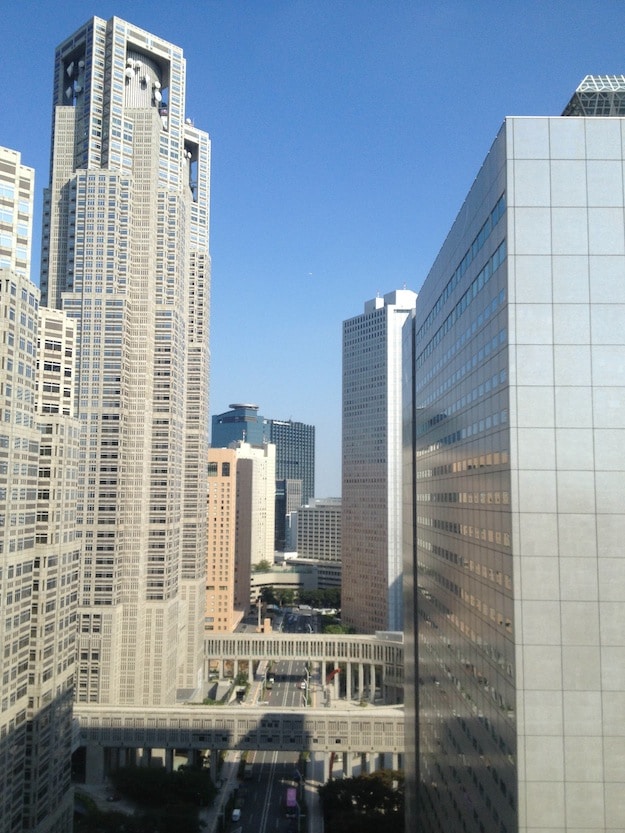
We’re not backpackers, but we’ve been on the move constantly during our six weeks in Japan. We’ve experienced a range of accommodations, but none for longer than five nights–at the Washington Hotel in Shinjuku, Tokyo. We normally select our lodging just the day before arrival. Our only criteria are that we’re in walking distance to the center of town, if not the train station, and that we’ll have a Wi-Fi connection. We budget under $100 a night, and find options between $60-90 more often than we do places costing upwards of a hundred. Here’s how the stays seem to be shaking out.
Note: We wrote this after a six-week trip years ago; here’s what’s changed and what hasn’t.
Hotels in Japan
Our introduction to hotels in Japan began in Tokyo, but continues to describe a wide range of places. For the most part, the service amenities are as you’d expect: small rooms, fancy toilets, hot water for tea, small fridge, TV (useless to us), toiletries, hair dryer, robes, and towels. We share these hotels with businessmen mostly, but also with tourists (Japanese and otherwise), and sporting or convention groups.
A standard Japanese hotel is distinct from the American version in a few ways: trouser presses on every floor (but no iron in the room); vending machines offering hot and cold drinks, plus beer and whiskey highballs; and laundry facilities for guest use at about two to three dollars per load (including automatic soap dispensing).
The rooms are, of course, lots smaller than in the USA, and probably smaller than the tiny old rooms in some central New York or Paris hotels. We learned that a room can be so small that the tub and sink use the same faucet, that Tom has to enter the bathroom sideways, and it isn’t practical for both of us to be out of bed at the same time.
Shinjuku Washington Hotel, Tokyo (giant well-respected hotel near the Hilton, but at half the price)
APA Hotel Kodenmacho-Ekimae, Tokyo (for businessmen all the way)
Kanazawa Manten Hotel, Kanazawa (special shout-out for calling the taxi to take me to urgent care)
Comfort Hotel, Nara (breakfast included)
Hotel Green Selec, Sendai (any port in a storm.)
Hostels in Japan
Affordable hostels are marketed to ‘backpackers,’ but their price and location attract many others. In most hostels, bathrooms are right in the room, and like the hotels, the toilet spaces appear to be inserted pods, requiring you to step over a riser to the throne. Rooms might be smaller than at the average hotels, and the toilets are regular devices with no butt washing or bidet buttons. Toiletries are provided in bulk and towels are provided, but no robes, slippers, or public bath. And don’t expect your room to be made up daily. Whatever few amenities you might give up at such hostels, though, are more than made up for with friendly staff, a kitchen and lounge, and easy Wi-Fi. Most hostels have their recommendations for nearby restaurants already written out, and tend to be staffed by young, well-traveled people.
K’s House Takayama, Takayama
K’s House Hiroshima, Hiroshima (Discounts for staying at multiple K’s Houses across Japan begin on your third city stay.)
JR Hotels: Staying Near the Train Station
These may not always be named the “JR” (Japan Rail) hotel, but the gist of these hotels is that they are directly in or extremely close to the main train station in town. Most are quite posh, with prices to match, but some are a real bargain and a godsend. The advantages, besides location, include on-premise restaurants and easy access to the convenience stores and shopping in the stations’ mall of shops. (I found dinner and socks.) Supposedly they offer a discount to JR Rail Pass users, but we booked ahead and forgot to ask.
JR Kyushu Hotel, Kagoshima
Ryokans: Traditional Japanese Inns
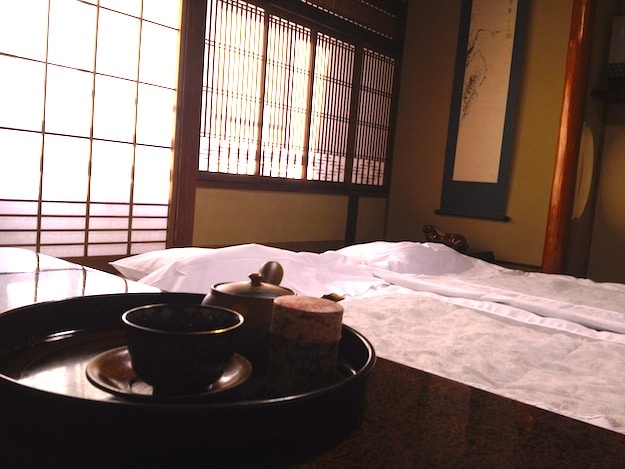
We stayed at four ryokans during our six weeks here. These are more traditional Japanese style guest houses, generally operated by a family that lives elsewhere on the property. Breakfasts and dinners may be included or offered separately. Rooms consist of tatami (grass mats) floors, a tea table where tea is offered upon arrival and again refreshed before your return in the evening. Futon mattresses may be rolled up in a closet or already placed on the floor, and a few hooks are provided to hang your clothes. Towels and robes and slippers are provided, and if you’ve worn shoes or slippers that far into the house, they will definitely come off when you enter your room. You might consider having the toilet down the hall a disadvantage, but with that comes the advantage of a Japanese bath at your disposal. After a thorough cleaning with a hand-held shower (or bucket) you may enter the hot water (onsen, or hot spring) bath for some bedtime relaxation. Most often there are separate baths for men and women, and women, at least, may use the bath privately. A few facilities have joined baths, so you can clean and relax at the same time as your mate. A few have private toilet and bath in the room, and the most traditional have a sitting area in front of the windows, with a table and a couple chairs.
If stairs or floor-sitting are a concern, however, you can ask specifically about ryokans with Western-style beds and private facilities.
Chuokan Shimizuya Ryokan, Nagano (First rate. Our highest recommendations.)
Ryokan Matsukaze, Matsumoto (Very nice. The walk from station involves going up and down stairs over the tracks, so arrange a lift from the ryokan.)
Oyado Chikara Sou, Takayama (Sweetest hostess, but a bit of a walk into town.)
Kajiyabekkan Ramakkoro Yamaneko Yado, Higashiyama (I mistook this for being in Ichinoseki. I was only 15 KM off, and on the wrong side of the mountains from our ultimate destination, Hiraizumi. But if you want to float the Geibikei Gorge, short for gorgeous, stay here.)
Capsule Hotels in Japan
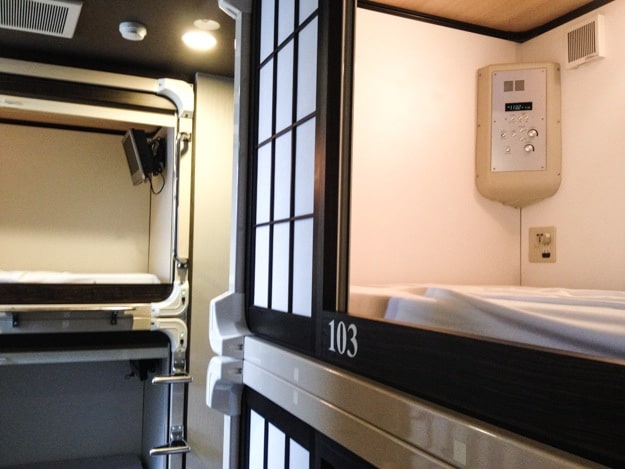
More like booking a sleeping berth on a train, many of the capsule hotels offer both the capsule compartments and a more standard hostel style room. I admit, we skipped the capsule, but I did take a look and found them to be wired for private light, clock, etc., and accompanied by good size lockers for storing your bag. Because each capsule has a sliding door, they provide lots more privacy than, say, the bunkrooms on the Camino de Santiago. Our room was a cross between a hostel and a ryokan, with tatami floor, fold out mattresses, storage beneath the bed platform, a super fancy toilet that opened and closed its lid as you entered and left the bathroom, and a corner shower with adjustable shower heads and sufficient ledge space. In Kyoto, our only capsule hotel experience to date, all the staff were extremely friendly and helpful. Like a hostel, we could help ourselves to coffee or tea, use the common refrigerator, and hang out in in the lounge area to read or eat our breakfast. Unfortunately, the capsule ryokan we stayed in in Kyoto is now closed, but there are many to choose from.
Ryokans in Kyoto.
With only one exception, no matter where we were or what type of property we stayed in, we found our temporary homes to be clean, safe, and highly accommodating. (The one exception, in Nikko, was evidently not Japanese-owned or operated. In fact we were never sure if management was there at all, since we couldn’t find them to arrange an additional night.)
We’ve had hosts walk us to the bus stop, drive us to the train station, turn to a neighbor if they need assistance communicating with us, and gracefully demonstrate proper etiquette for various situations. Despite the fact that a couple local restaurant establishments have turned us away when they have plenty of seating available (they may as well post a sign that says ‘Foreigners Not Welcome’), the tradition of impeccable hospitality is alive in all sorts of Japan’s accommodations.
Convenient Japan Accommodation Booking Engines
We used a bunch of online search engines for booking:
- Booking.com
- Agoda.com (often the best for Asia)
- Hotels.com
- Japan National Tourism Organization
- Japanican: Online Booking via Japan tourism
Read more about the hospitality of Kanazawa, Japan here.
Frequently Asked Questions: Accommodations in Japan
What are the main types of accommodations in Japan?
Japan offers a wide range of lodging, including standard hotels, budget hostels, JR hotels attached to train stations, traditional ryokans (Japanese-style inns with tatami floors and onsen baths), and capsule hotels. Each varies in price, privacy, and cultural experience, so the right choice often depends on your budget and how much of a traditional experience you want.
How much does a hotel room cost in Japan now?
Prices have risen substantially since the mid-2010s due to a tourism boom and a historically weak yen. As of 2025, mid-range city hotels in Tokyo commonly run ¥15,000–20,000 (roughly $100–$135) a night, and even budget hotel brands have seen double-digit percentage increases year over year. Ryokans in popular areas during peak season can run considerably higher. It’s worth budgeting more than older guides suggest.
What’s the difference between a ryokan and a hotel in Japan?
A ryokan is a traditional Japanese guesthouse with tatami-mat rooms, futon bedding, and often an onsen (hot spring) bath, sometimes with breakfast and dinner included. Hotels are more Western in layout, with beds, private bathrooms, and fewer cultural rituals. Ryokans typically offer a more immersive experience but can cost more, especially at the higher end.
Are capsule hotels comfortable for older or first-time travelers?
Modern capsule hotels have moved well beyond the old image of cramped pods for tired commuters. Many now offer sliding-door privacy, individual lighting and outlets, comfortable bedding, and shared lounges or baths. They can be a good low-cost option, though travelers who value more space and privacy may prefer a standard hotel room or ryokan.
Do I need to book accommodations in Japan in advance?
Increasingly, yes. With record numbers of international visitors and limited hotel supply in popular cities, booking well ahead—especially during cherry blossom season, autumn foliage season, and major holidays—is now strongly recommended rather than optional, a shift from the more spontaneous booking style that was possible a decade ago.
Is the JR Rail Pass still worth it for train travel between accommodations?
The nationwide JR Rail Pass rose in price by roughly 65–77% in October 2023, so it’s no longer the automatic bargain it once was. Whether it still pays off depends on your itinerary—travelers visiting several distant regions may still benefit, but those sticking to one or two areas may find point-to-point tickets or regional passes cheaper.
Are Western-style toilets and bidets common in Japanese accommodations?
Yes, heated bidet toilets (washlets) are now standard in the vast majority of hotels, ryokans, and even many hostels and capsule hotels across Japan, a change from a decade ago when budget accommodations more often had simple Japanese-style facilities.

Ryokans are stunning – I always get lazy and never book one but then wish I did when I get there lol
Yeah, I thought the same, that it would be a hassle to book, but it seems they are mostly included in the major online booking agencies these days. Japanican (Japan Tourism’s onling booking service) is great because it allows you to search by ryokan or hotel or both. Prices do seem all over the map, but we’re in a shoulder season, and also in the area most effected by the earthquake and aftermath. What I love most about ryokans is the floor space–enough to do a few ‘on the road” workout exercises. Thanks, Matt.
Hah! I thought you might have me beat. All the time I’ve spent in Japan and never have I stayed at a capsule hotel. I will though…I will.
I love a ryokan. Maybe my all-time favorite accommodation anywhere in the world. You just can’t beat it.
Glad you are really getting the full experience!
Thanks, Corrine. Agreed, it just doesn’t count staying in a room in a capsule hotel, not a capsule in a capsule hotel! But I did notice they applied the space saving engineering to the rooms, with the nifty storage area within the bed platform, etc. I didn’t even notice until I snapped the photo that the capsules each had their own TV! Headphones required, I hope. I think my next business should be opening Capsule Hotels along the Camino de Santiago. And you’re right: ryokans are unbeatable! Thanks for the note.
We love Japan and go there annually to ski, and by my reckoning we are a bit over 50. We also have experienced many accommodation options and do love the ryokans. We find that the Japanese people are very hospitable and always prepared to go out of their way for you, just as you described. Looking forward to reading more of your tales.
I wrote this before we stayed in a great little place near Ueda, called Lodge Alice. You can ski out from the doorstep. Wonderful, helpful owners. Thanks for readinng the post.