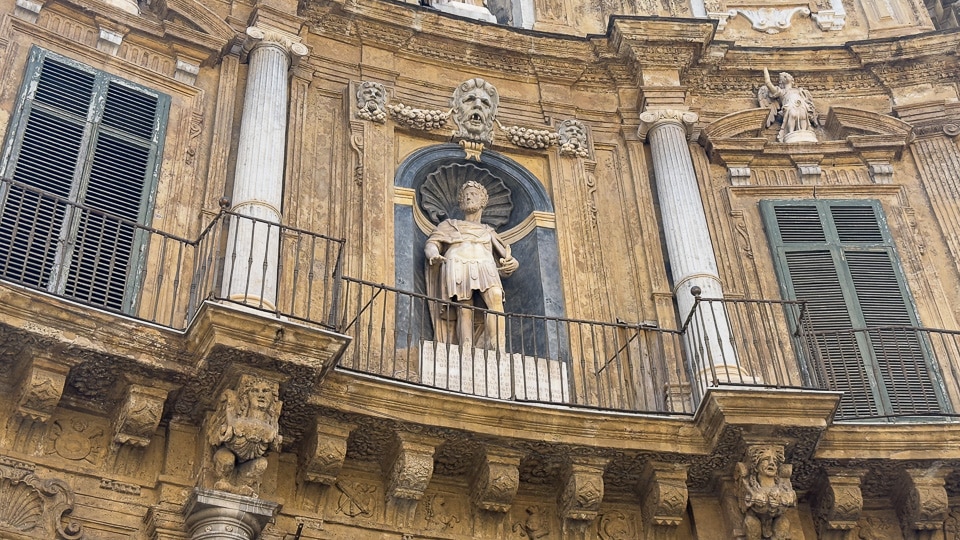
As you wander around Palermo’s historic center on your first couple of days in the city, you’ll inevitably crisscross Corso Vittorio Emanuele many times. From this main artery, sweeping from the port up to the Cathedral and Royal Palace, you might notice that the older winding streets on either side are actually at a higher level than the Vittorio Emanuele. How is it, you might ask, that the narrow medieval streets are above the newer Cassaro, as Corso Vittorio Emanuele is called? The answer came to us through our course, “Palermo and the Evolution of the City”, with Elective Study Abroad. Imagine you are on a dig: here’s one example of where you’ll literally find the old above the new!
Thanks to our architect-instructor, we learned the Cassaro was excavated and widened more than 300 years ago to smooth the route to and from the port.
We also learned that Palermo, on the north coast of Sicily, represents many aspects of Italian culture. In it we saw both the spiritual and mundane. We witnessed that Palermo is home to pilgrims and to bachelor parties, to a big port and to small independent business owners. We traced its stages of renaissance and renovations alternating with periods of decay and corruption. We discovered the city reveals signs of ancient Phoenicians and Romans, mixed with remnants of Moorish and Jewish quarters. Both narrow alleys and broad streets showcase these layers of history, the breadth of political and social views, and the modern adaptations that make Palermo a livable city.
We spent a week in Palermo studying the evolution of the city, plus a few extra days on our own. So, you’ll find our report here is part visitor guide and part summary of what our Elective Study Abroad course taught us.
Studying the evolution of Palermo
We hadn’t been to Sicily in over ten years, and back then our visit was mostly concentrated in Syracuse and Agrigento. A study abroad course was the great motivator for our return to Sicily and an excellent way to get to know a complicated city like Palermo.
This was our second course with Elective Study Abroad, the previous one a delightful study of flânerie and the French art of living in Montpellier, France. We knew we could rely on an interesting advance reading and watch list to prepare us, on an expert course instructor to enrich our experiences in the city, and plenty of free time – with a long list of recommendations – to allow us to digest the information at our own pace.
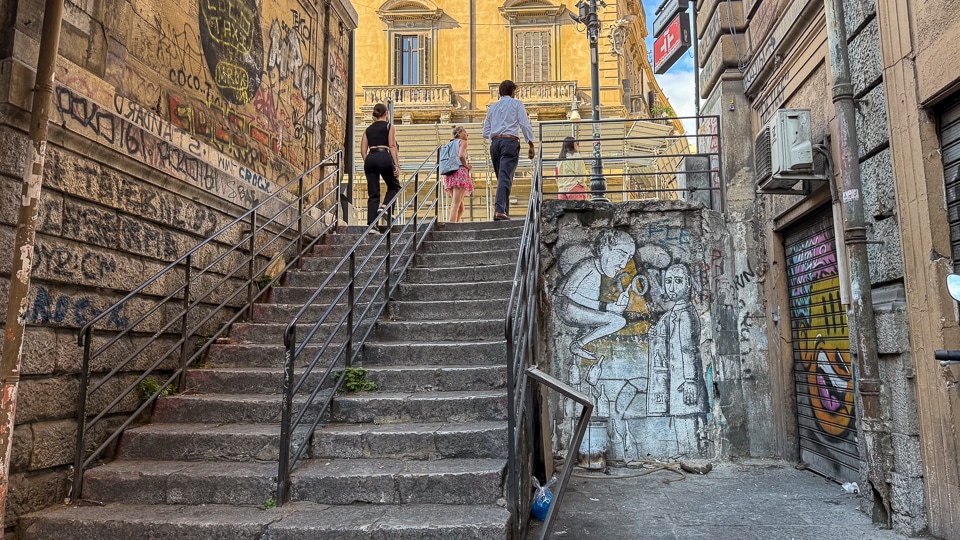
The “Evolution of the City” course in Palermo provided all that, as taught by the knowledgeable Giuseppe Ferrarella, whose doctoral dissertation in architecture explored how changes in the city’s terrain reveal so much about Palermo’s past. Our overview included discoveries of major excavations to build the town’s main arteries, routes of former rivers, remnants of Roman and Phoenician walls and winding streets, and extant examples of Byzantine art and architecture. Many facades today acknowledge the 17th- and 18th-century political and social changes that translated into the city layout we see today.
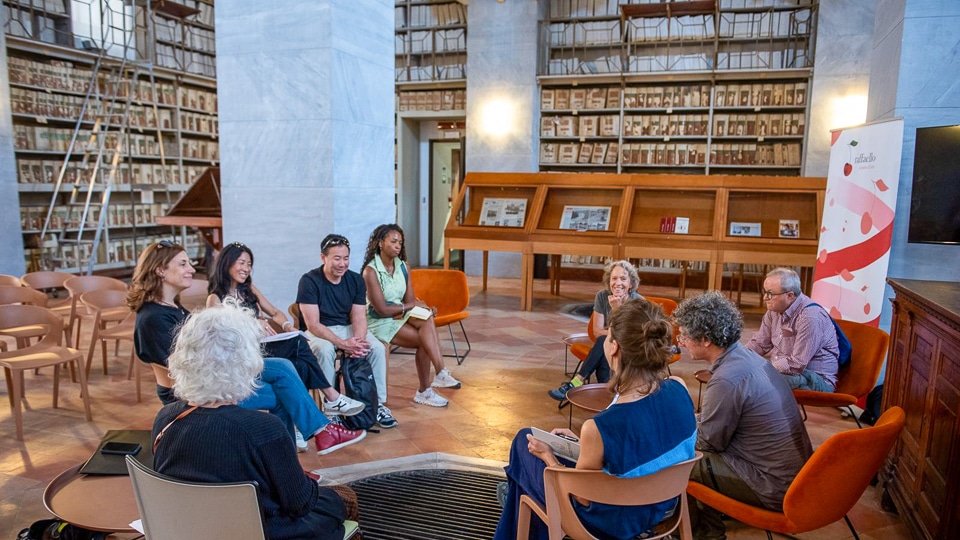
Walking and talking with Giuseppe, who teaches at the University of Palermo and participates in the International Center for Architectural Design and Archeology research group, opened up our view of the city. Rather than seeing the surface of shops, restaurants, gardens, and historic monuments, our small group – just six of us – saw the “bones” of the city, the framework upon which it was built. (We’ll get to more bone stories below!) For inquisitive travelers, this is the way to understand a new place and connect with its present. Elective Study Abroad’s approach will certainly serve us as we explore other cities around the world.
No matter your course of study or interests, the historic center of Palermo is fun to wander.
Is an Elective Study Abroad program right for you?
Here’s what you can expect:
- A stay of one week in a 4-star hotel
- Daily discussions over breakfast
- Daily field seminars, led by your expert instructor, out and about in the city
- Afternoons free for self-guided study, with plenty of instructor recommendations, according to your interests
- Extracurriculars: a couple of optional activities to complement the course, for a fee, and based on interests and availability
- Small cohorts: groups of 10 maximum
- Ample free time allowing everyone to either share meals or go off on their own, to relax, or wander, or enjoy the company of engaging, like-minded, life-long learners.
A short history of Palermo, layer by layer
It might be easiest to understand Palermo’s history by envisioning its setting, especially as viewed from the sea. The island of Sicily was the crossroads for ancient navigation on the Mediterranean, providing a visible shoreline and substantial resources in the middle of the sea. Palermo, on the northwest corner of the triangular isle, was certainly an identifiable port. Not only is it nestled between two pronounced peaks (Monte Pellegrino and Monte Grifone) and wrapped by the range to its southwest, but the port itself was framed by two rivers running to the sea on either side of a bold promontory.
The Phoenician settlement on this promontory within the natural harbor gave Palermo its name: Panormos, or “all-port.” The two rivers, the Papireto and the Kemonia (now largely buried), provided fresh water, drawing Roman settlements and, from 831, Arab settlements. It’s worth noting that both cultures were particularly advanced in their control and use of water, and both valued this location for trade and movement of key populations.
One Arabic-derived name, Kalsa (from al-Khalisa), still appears on maps, identifying a now-trendy neighborhood close to the sea. The city, in fact, became an Arab capital, with gardens, irrigation, markets, and quarters.
From most visitors’ perspective, the Norman era, which began with their capture of Palermo in 1072, is the most striking. These middle centuries brought together Latin, Greek, and Arab craftsmen and administrators, who managed to coexist.
As the centuries passed, Palermo naturally fell under the control of whoever was controlling the nearby mainlands. There were Germanic (Swabian) and Spanish kingdoms, led by Aragonese, Habsburg, and Bourbon dynasties. In hindsight, it appears the city was quickly transformed during this era – and this was the focus of our studies. The hills and slopes leading to the seaside cliffs were excavated to even the way for easier transfer to and from the port. The city’s main arteries (now Corso Vittorio Emanuele and Via Maqueda, joining at the Quattro Canti intersection) were established. This grid, over the winding streets and alleyways around it, is what we see today.
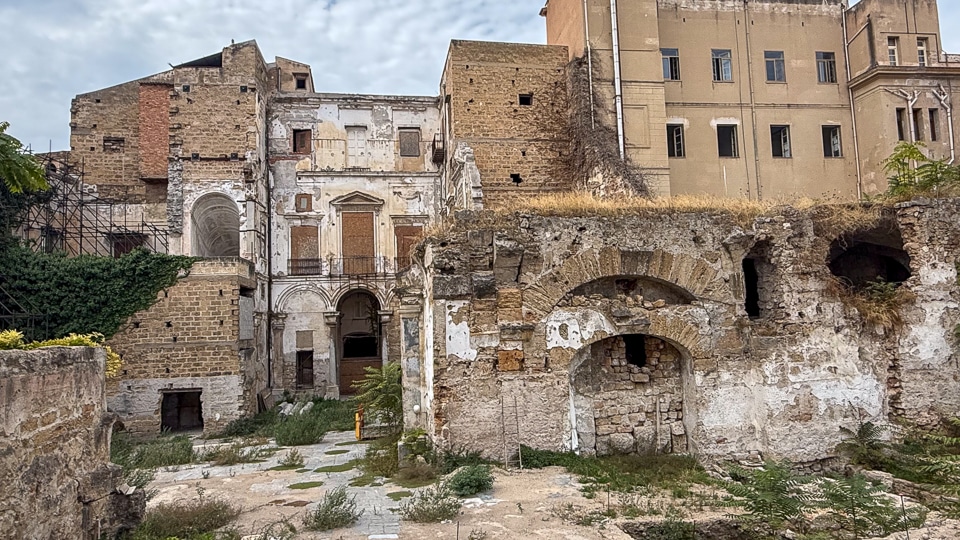
Palermo changed in the 20th century, too, mostly due to World War II bombings. Post-war cycles included speculation, abandonment of the city center, and extensive rebuilding and renovation. But in some places – behind Palazzo Riso, for example – post-war clearing revealed more interesting layers from the ancient city.
All of these layers of building – earth moving, street building, deconstruction and reconstruction – amount to what our class called the city’s palimpsest. Just as parchment paper was reused by scraping off prior writing, Palermo’s city plan was recycled by razing parts of one version to overlay another.
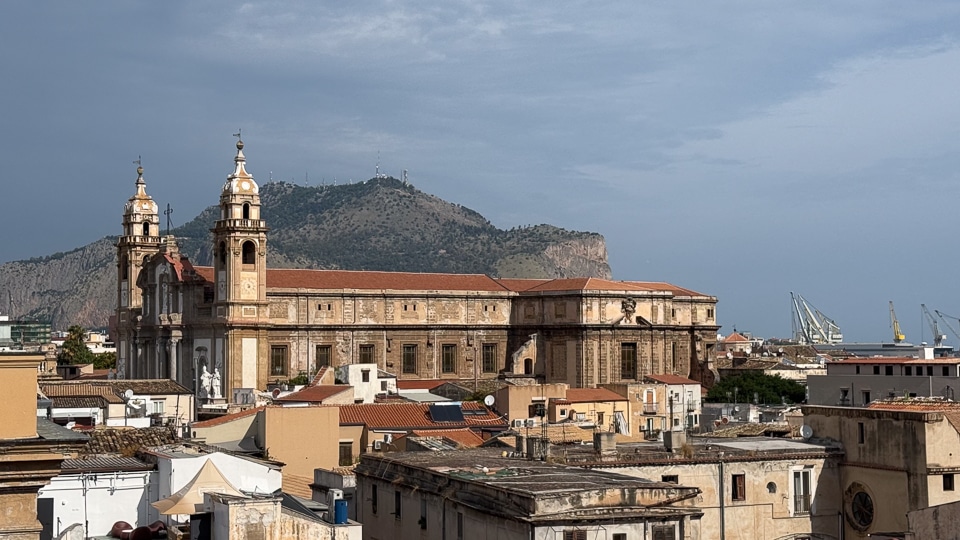
Things to do in Palermo
While Palermo is fun to visit for all sorts of reasons – including climate, food, and Sicilian culture – the monuments and neighborhoods for which it is best known are of interest to both tourists and curious students like us.
Arab-Norman circuit
A group of Arab-Norman buildings in Palermo (with a couple more in nearby Monreale and Cefalù) drew the attention of UNESCO, which listed these together in 2015 in recognition of their cultural heritage. Their value is in their great mix of styles and periods, exactly what our curriculum was focused on. In a single building we could see Arabic-style painted ceilings, Byzantine mosaics and Norman plans together.
Palazzo dei Normanni, the royal palace, sits at the highest point of the original settlement. From outside, it’s quite easy to see how this huge complex grew from its oldest parts, like the Torre Pisana, to encompass the Renaissance and Baroque phases. Buy tickets for entry to see the jewels within: the chapel and apartments.
The Palatine Chapel, commissioned by Sicily’s Roger II in the 12th century, combines Byzantine, Norman, and Fatimid styles, drawing on the three dominant cultures in Sicily at the time. The big draw is the mosaics, beautifully detailed and well-preserved. You’ll find yourself waiting in line, no doubt, but the Palatine Chapel is well worth it.
The Royal Apartments draw smaller crowds than the chapel. Skip the doorway peek into the Great Hall, where visitors bunch up, and you’ll have the rooms nearly to yourself. The apartment rooms are rich with detailed paintings, frescoes, tapestries, and architectural detail.
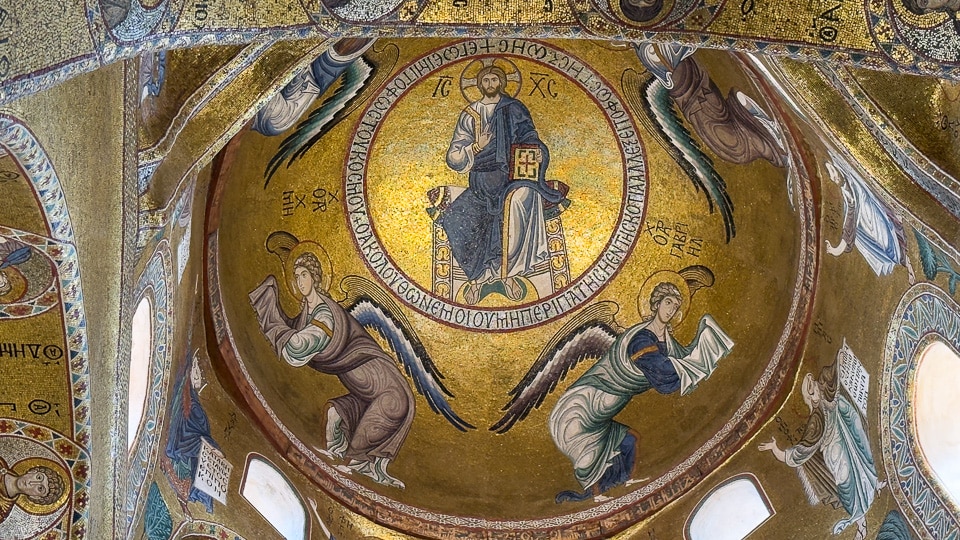
La Martorana. Its formal name is Santa Maria dell’Ammiraglio, or Church of St. Mary of the Admiral. La Martorana overlooks Piazza Bellini, just a few steps from Quattro Canti, and just opposite another landmark, the Norman church of San Cataldo. Examining the outstanding mosaics in La Martorana, we could see the passage of time reflected in the mosaic details, which used Greek lettering in the older sections and Latin in later parts.
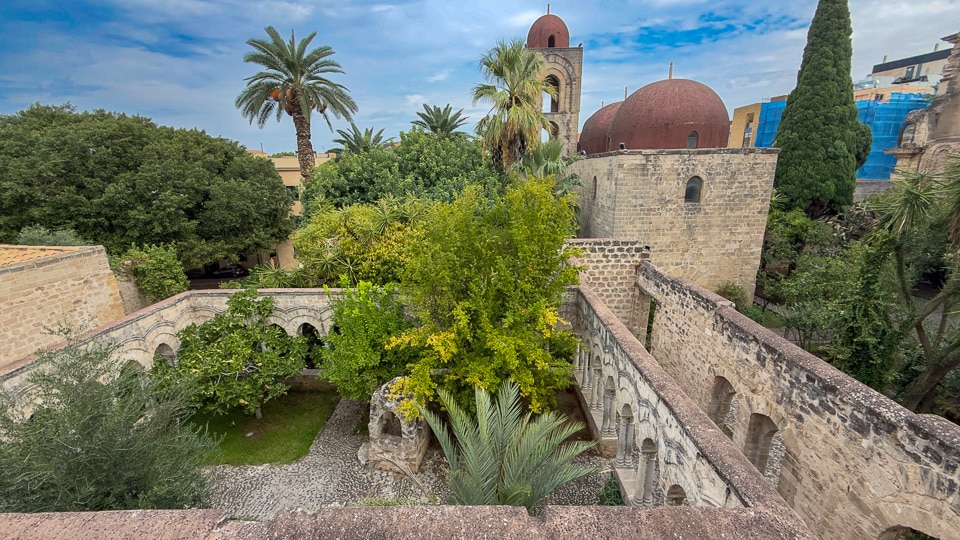
San Giovanni degli Eremiti, not far from the bustling palace square, is a lovely example of Byzantine and Norman architecture. The remains of the chapel, cloister and gardens are pleasant to walk through and imagine in their earlier times.
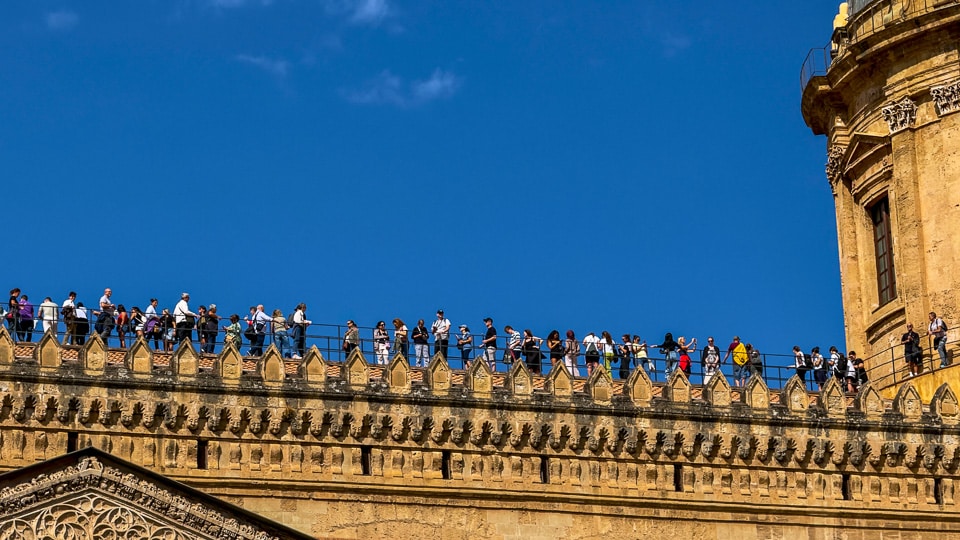
The Palermo Cathedral dominates the upper reaches of the historic center, due to its sheer size and wild architectural patterns, not to mention the string of people constantly moving across its roof. We happily checked it out from ground level. The interior displays a rather bland neoclassical design.
More sites in the historic center
Porta Nuova. Whether you need to or not, work your way around to the outside of the Porta Nuova for an impressive entry to the old city. The gate, near the palace, is on the highest ground, pointing down the major Corso Vittorio Emanuele (also called the Cassaro) to the opposite gate, Porta Felice, at portside. The massive figures holding up the gate represent conquered Moors.
Piazza Bologni is notable as the first of the squares along the Cassaro, setting the rhythmic pattern of piazzas with palaces strung together along the avenue leading down to the water. Across the square stands Palazzo Riso, now the Museum of Contemporary Art.
Quattro Canti is the intersection of Palermo’s two main arteries, Vittorio Emanuele and Via Maqueda. The four corners each rise in tiers: a fountain for each season, a Spanish king, and one of Palermo’s patron saints, in a display of post-Renaissance order slapped over the old buildings.
Santa Caterina. While you are checking out Piazza Bellini, duck into Santa Caterina church and monastery for a look, allowing time for a stop at the bakery, I Segreti del Chiostro, noted in the food listings below.
Chiesa di Sant’Antonio Abate on Via Roma might be a priority stop, if not for the church interior, for its tower. It was originally the civic bell tower of the city, another landmark for sailors approaching. The climb to the top is neither difficult nor crowded. You’ll be rewarded with views over the city to the port and mountains.
Kalsa Neighborhood. It’s pleasant to walk in the Kalsa neighborhood, one of Palermo’s oldest, because the periods of decline and renewal are readily apparent. Today’s visitors will find restored palazzi, galleries, restaurants and bars, and good street art.
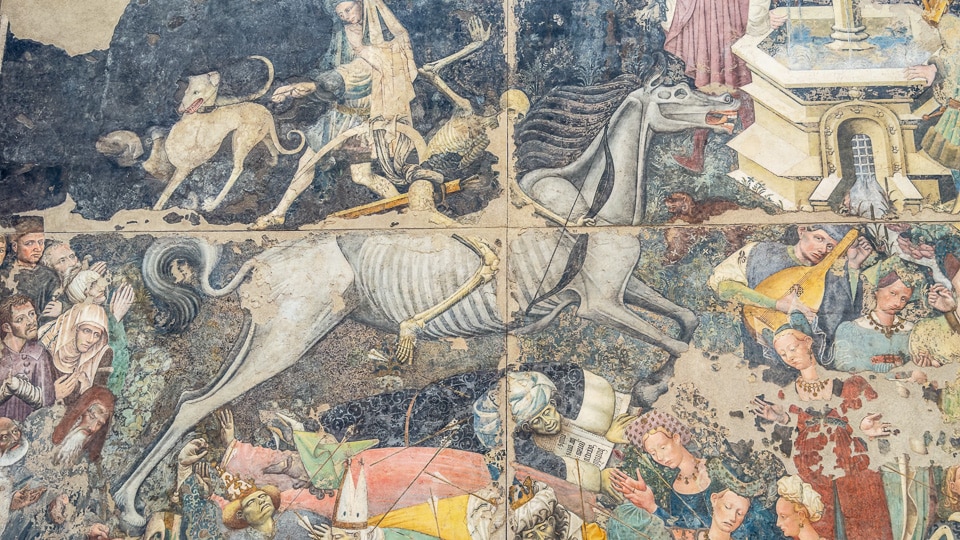
The Palazzo Abatellis. In Kalsa, this is home to the famous Triumph of Death fresco from around 1445, as well as Antonello da Messina’s Annunciata, Francesco Laurana’s Bust of a Gentlewoman, and other important works. We were especially excited to see the Triumph of Death after watching Wim Wenders’ Palermo Shooting. The film was recommended in our pre-course preparations, and it helped set the tone for our visit.
Teatro Massimo. Just a bit out of the historic center in the “newer” 19th-century part of town, Teatro Massimo is every bit the elegant home to ballet and opera that you’d hope it to be. This building, like so many of the palaces, was closed for decades before reopening in 1997. Lucky us: Elective arranged an “extra-curricular” activity for us, with tickets to the Ballet of the Teatro Massimo di Palermo’s production of Sleeping Beauty. Otherwise, guided tours of the theater, including backstage options, are available to the public.
Markets. You’ll surely come across the Ballarò and Vucciria markets. Their layout comes from the Arab-era souk pattern.
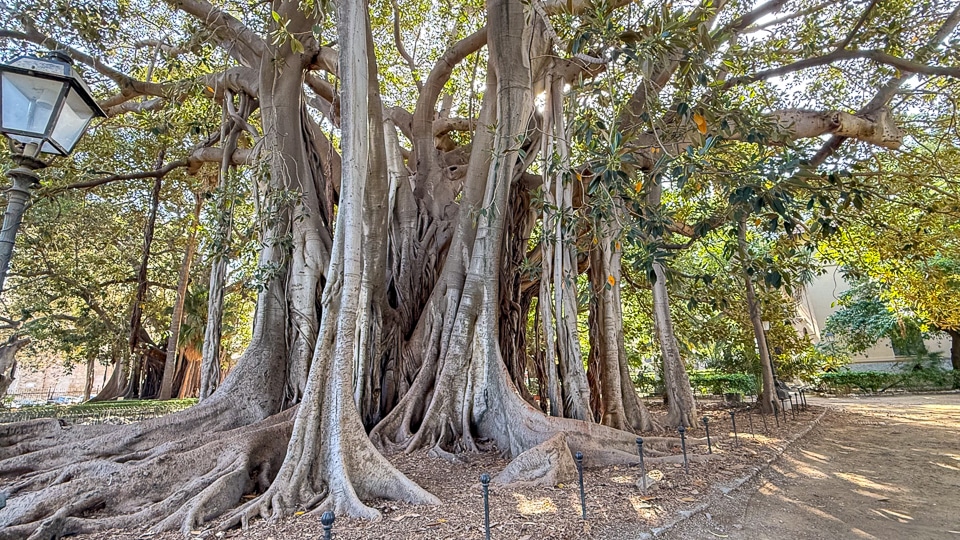
Palermo Botanical Garden. The inviting Botanical Garden was founded in 1789 by the University of Palermo’s botany department. It covers some 30 acres (10 hectares). Originally featuring many medicinal plants, the garden was intended to promote learning and health, and is still managed by the botany department. Today, the huge ficus trees grab most of the attention, while fruit trees, shrubs, herbs, a greenhouse and water features provide variety and calm.
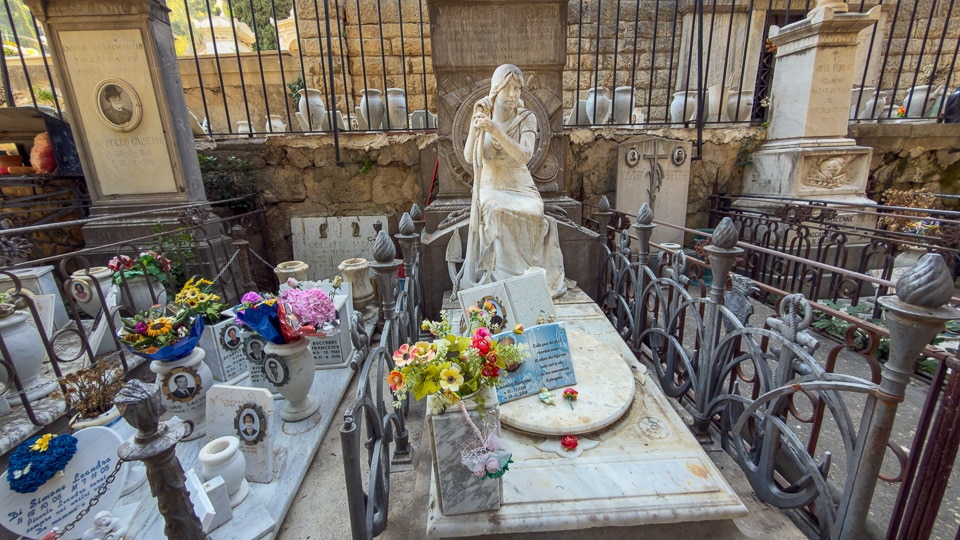
Religious sites, catacombs, cemeteries and the culture of death
No trip to Palermo would be complete without a visit to a cemetery or the catacombs, or both! From our perspective, studying the evolution of Palermo, we could see that the position of convents and churches influenced the growth patterns of the city.
While these sites might interest pilgrims more than tourists, our visit to Santa Maria di Gesù was a favorite stop on our study itinerary. The monumental cemetery is crowded with community graves, grouping people by neighborhoods or parishes or other associations, and displaying photos or likenesses of the dead alongside their stones.
In the convent, unexpectedly, we were introduced to history in the making. The life story of San Benedetto il Moro (1526 – 1589) as told by Fra’ Carmelo (who likewise didn’t expect our visit) revealed that the incorrupt body of the saint was consumed by Sicily’s wildfires in 2023. We saw the burnt bones while we learned the story.
Our experience was further enhanced by the chance encounter with a group of nuns from Brazil, with whom we climbed the mountainside to see where Benedetto took refuge.
The views from this vantage point, by the way, are the very same depicted by various Grand Tour painters. The vista looks northwest across the city to Monte Pellegrino opposite. Like a bookend, that peak is home to the shrine to Santa Rosalia, the patron saint of Palermo. Her July Festino might interest those who love to join such celebrations.
Unfortunately, we didn’t make it to the Capuchin Catacombs, but wanted to. What seems so unusual to us – the fully clothed, embalmed bodies of some of Palermo’s finest – is part of the culture here, where death is always near life.
What to eat in Palermo
Some of the dishes that caught our attention were specifically from Palermo, others more typical of Catania (in eastern Sicily) or Sicily overall. Like the architectural layers of Palermo, Sicilian plates often reflect the successive cultural influences on the city. We enjoyed the range of dishes, the departures from pasta, the interesting street food and starters, and, of course, the gelato, granita and sweets.
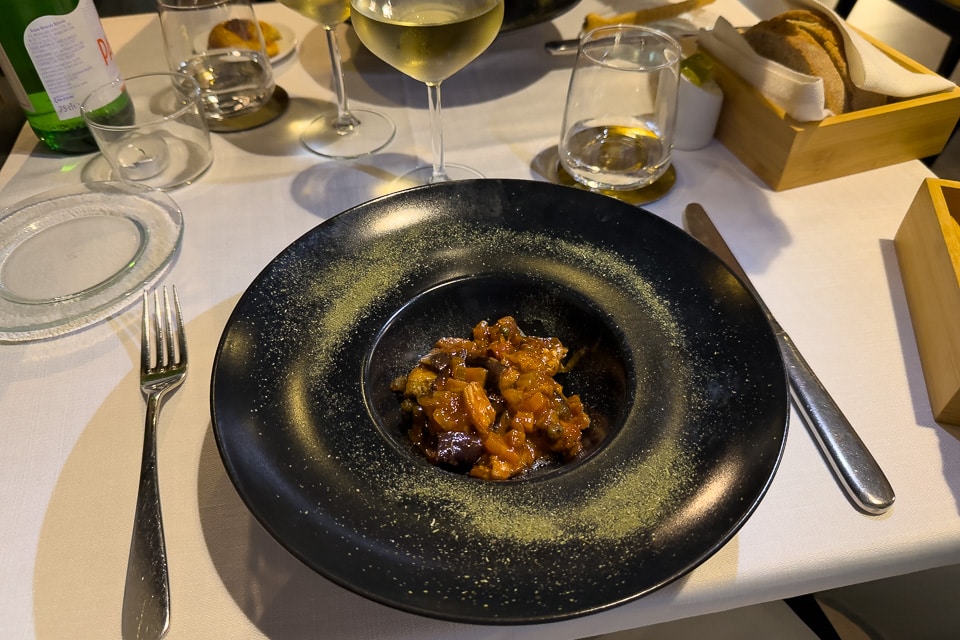
Typical dishes
Palermo’s must-try foods are panelle, arancine, sfincione, pasta con le sarde, caponata and cannoli.
Caponata: A sweet-and-sour mix of eggplant, celery, olives, and capers, served cold or at room temperature. This is the sort of dish that everyone swears their mother makes best. It’s the ultimate comfort food, slow cooked and best enjoyed at room temp as a first course.
Pasta alla Norma: More eggplant. This Catanian dish combines tomato, fried eggplant, basil, and salted ricotta, and is said to be named for Bellini’s opera (but why, we ask). On most restaurant menus.
Pasta con le sarde: A distinctly Palermitan pasta featuring the ubiquitous sardines with wild fennel, pine nuts, raisins, and saffron. It’s a good example of the sweet-savory Arab influence.
Panelle: Thin chickpea-flour fritters, fried until crisp and often tucked into a sesame roll with a squeeze of lemon. They’re a classic street snack, and the chickpea tradition is often linked to the island’s Arab-era cooking.
Arancine: In Palermo they’re arancine, feminine and round, named for the orange they resemble. Catania says arancini, masculine and cone-shaped, like Etna. Classic fillings are meat ragù with peas, or ham and cheese.
Sfincione: A thick, spongy street-bakery pizza topped with tomato, onions, anchovies, caciocavallo cheese, and breadcrumbs. It’s closer to focaccia than to Neapolitan pizza. The name is thought to come from the Latin or Arabic word for sponge, which suits it.
Cannoli: Fried pastry tubes filled with sweetened sheep’s-milk ricotta, ideally filled to order so the shell stays crisp. Look for ones topped with candied orange or chopped pistachios, and skip those from the pre-filled display.
Pistachio gelato: You’ll find pistachios presented in many ways, but our favorite is gelato! The best pistachios come from Bronte, in the Catania area, so you’ll find “Bronte” on menus. In Palermo, gelato or granita is often served in a brioche col tuppo, the topknot bun, for breakfast.
Frutta martorana: Marzipan shaped and painted like fruit, named for the Martorana convent mentioned above, another link to the Arab-Norman era.
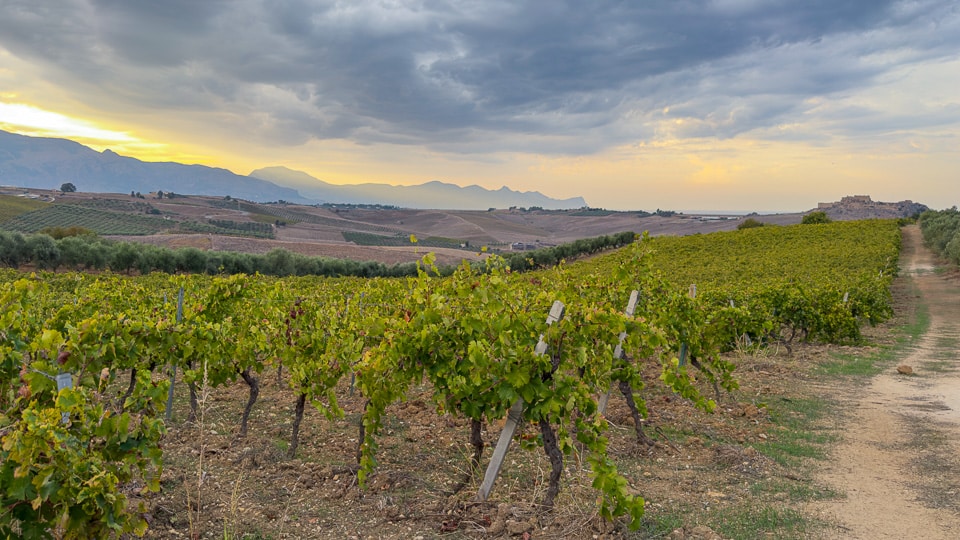
Local drinks
While Palermo doesn’t really have a signature cocktail (Aperol spritzes are from Northern Italy), spritzes of all sorts are popular. The local wines of note are Marsala, from the island’s west coast, and very nice reds and whites from Etna in the east. Amari, enjoyed across Sicily as after-dinner digestivi, are served neat or on ice. (Or in a Negroni, anyone?)
For a special treat, drive just 45 minutes out of town to visit a local winery, like Elios Natural Wines near the picturesque town of Alcamo. We found sunset is a beautiful time to get acquainted with owner Nicola, the land, and the white, red, and orange wines produced here.
Bars and restaurants
Our short summary of a variety of places to enjoy lunch, dinner, drinks, or a refreshing stop along your way.
Quattroventi. A lovely small restaurant featuring comfort food executed with style from the day’s freshest ingredients.
Dal Barone. A popular wine bar around the corner from Grand Hotel Piazza Borsa, with young people spilling out onto the street.
I Segreti del Chiostro. Traditional pastry shop inside a former convent on Piazza Bellini. Cannoli from the nuns’ recipes: enough said.
Bar Touring. Arancine, tested and approved. Across the street from the Botanical Garden.
Molo Sant’Erasmo. Trattoria specializing in fish, with a refreshing location at water’s edge.
A’nica Ristorante & Pizza. Relaxed, contemporary, and delicious, for pastas and for sizzling steak, in Kalsa neighborhood.
Osteria Santa Cecilia. Unassuming, fresh, and perfect for a light bite. Located opposite yet another Palermo theater, the Real Teatro Santa Cecilia.
Ballarak Magione. Brewpub on the popular Piazza Magione. A good place to start or end your evening.
A’ Putia – Salumeria Panini e Vini. For delicious panini sandwiches or salads, when you’ve seen enough pasta.
Bagliore Gelateria Artigianale. It may not be the best, but it’s the best we tried. Enjoy while gazing at the Teatro Politeama across the street.
Ristorante Quattro Mani. Go for the fish and fine service.
Where to stay in Palermo
Grand Hotel Piazza Borsa. Grand in the old style, established in a former convent. Excellent location.
Palermo Rooms. Billed as a B&B, but without the breakfast. This low-budget place was right for us, because it was walking distance to where we’d rent a car. Bonus points for the owner’s recommendation to eat at Quattroventi around the corner.
Final thoughts
Palermo keeps its layers and its daily life in play at once. We came to study how the city evolved, and we left seeing it everywhere: in the Cassaro’s sunken line below the old winding streets, in cannoli made from the nuns’ recipes in a former convent, in panelle eaten on the street and a ballet at Teatro Massimo. Knowing where the city came from made every present moment richer. When you bring your curiosity as well as your appetite, Palermo rewards both.
Frequently Asked Questions: Visiting Palermo
Is Palermo worth visiting for travelers over 50?
Yes. Palermo packs nearly 3,000 years of history into a compact, walkable center, with Arab-Norman churches, Baroque piazzas and lively markets often just a few minutes apart. It rewards curious, unhurried travelers who enjoy history, food and opera as much as sightseeing. Plan for some uneven paving and a few stair climbs, and you’ll do fine.
How many days do you need in Palermo?
Three or four days covers the major sights of the historic center, including the Royal Palace and Palatine Chapel, the cathedral, La Martorana and Palazzo Abatellis. With a week, you can add day trips to Monreale and Cefalù, a winery visit, and slower days wandering the Kalsa neighborhood and the markets.
What are the Arab-Norman sites in Palermo?
UNESCO listed Arab-Norman Palermo and the cathedrals of Cefalù and Monreale as a World Heritage Site in 2015. In Palermo, the highlights are the Royal Palace (Palazzo dei Normanni) with its Palatine Chapel, the cathedral, La Martorana, San Cataldo, San Giovanni degli Eremiti, the Zisa palace and the Admiral’s Bridge. Together they show Byzantine mosaics, Islamic-style ceilings and Norman architecture side by side.
What food is Palermo known for?
Palermo is famous for street food: panelle (chickpea fritters), arancine (stuffed rice balls) and sfincione (a thick, spongy pizza). Look for pasta con le sarde, made with sardines, wild fennel, raisins and pine nuts, plus caponata and cannoli filled to order with sheep’s-milk ricotta. Many dishes reflect the island’s Arab heritage in their mix of sweet and savory.
What is the difference between arancine and arancini?
It depends on which side of Sicily you’re on. In Palermo they’re called arancine, a feminine word, and are round like the little oranges they’re named for. In Catania they’re arancini, masculine and cone-shaped, said to resemble Mount Etna.
Is Palermo’s historic center walkable?
Yes, and it’s easy to stay oriented. The old city is laid out around two main streets, Corso Vittorio Emanuele and Via Maqueda, which cross at the Quattro Canti. Expect cobblestones, uneven sidewalks and some uphill stretches, and note that the cathedral roof and the bell tower of Sant’Antonio Abate require stair climbs. Comfortable shoes matter more than a car here.
Can adults over 50 take a study abroad course in Palermo?
Yes. Organizations such as Elective Study Abroad run short, small-group courses designed for adult learners, pairing advance reading with guided walks led by local experts and plenty of free time. A week-long course on the evolution of the city is a deeper way to understand Palermo than a standard tour.